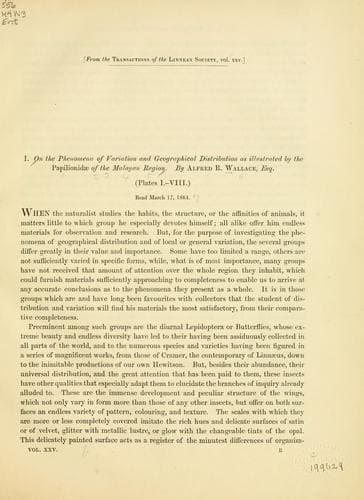
On the phenomena of variation and geographical distribution as illustrated by the Papilionidæ of the Malayan regionWallace, Alfred Russel
Science
On the phenomena of variation and geographical distribution as illustrated by the Papilionidæ of the Malayan region
Wallace, Alfred Russel
Papilionidae -- Malaysia -- Geographical distribution; Papilionidae -- Malaysia -- Variation
What, I would ask, are we to do with phenomena such as these? Are we to
rest content with that very simple, but at the same time very
unsatisfying explanation, that all these insects and other animals were
created exactly _as_ they are, and originally placed exactly _where_
they are, by the inscrutable will of their Creator, and that we have
nothing to do but to register the facts and wonder? Was this single
island selected for a fantastic display of creative power, merely to
excite a child-like and unreasoning admiration? Is all this appearance
of gradual modification by the action of natural causes—a modification
the successive steps of which we can almost trace—all delusive? Is this
harmony between the most diverse groups, all presenting analogous
phenomena, and indicating a dependence upon physical changes of which we
have independent evidence, all false testimony? If I could think so, the
study of nature would have lost for me its greatest charm. I should feel
as would the geologist, if you could convince him that his
interpretation of the earth’s past history was all a delusion—that
strata were never formed in the primeval ocean, and that the fossils he
so carefully collects and studies are no true record of a former living
world, but were all created just as they now are, and in the rocks where
he now finds them.
I must here express my own belief that none of these phenomena, however
apparently isolated pr insignificant, can ever stand alone—that not the
wing of a butterfly can change in form, or vary in colour, except in
harmony with, and as a part of, the grand march of nature. I believe,
therefore, that all the curious phenomena I have just recapitulated are
immediately dependent on the last series of changes, organic and
inorganic, in these regions; and as the phenomena presented by the
island of Celebes differ from those of all the surrounding islands, it
can, I conceive, only be because the past history of Celebes has been to
some extent unique and different from theirs. We must have much more
evidence to determine exactly in what that difference has consisted. At
present, I only see my way clear to one deduction, viz., that Celebes
represents one of the oldest parts of the archipelago, that it has been
formerly more completely isolated both from India and from Australia
than it is now, and that, amid all the mutations it has undergone, a
relic or substratum of the fauna and flora of some more ancient land has
been here preserved to us.
Public-domain text, read in full here on John Shaqi.
Reviews
Reviews
No reviews yet
Be the first to share your thoughts on this work.
Join the Discussion
Join the discussion
Sign in to leave a comment or review.
Sign InorCreate an account