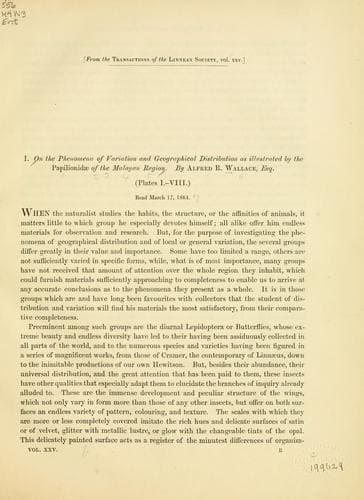
On the phenomena of variation and geographical distribution as illustrated by the Papilionidæ of the Malayan regionWallace, Alfred Russel
Science
On the phenomena of variation and geographical distribution as illustrated by the Papilionidæ of the Malayan region
Wallace, Alfred Russel
Papilionidae -- Malaysia -- Geographical distribution; Papilionidae -- Malaysia -- Variation
It is only since my return home, and since I have been able to compare
the productions of Celebes side by side with those of the surrounding
islands, that I have been fully impressed with their peculiarity, and
the great interest that attaches to them. The plants and the reptiles
are still almost unknown; and it is to be hoped that some enterprising
naturalist may soon devote himself to their study. The geology of the
country would also be well worth exploring, and its recent fossils would
be of especial interest as elucidating the changes which have led to its
present anomalous condition. This island stands, as it were, upon the
boundary-line between two worlds. On one side is that ancient Australian
fauna which preserves to the present day the facies of an early
geological epoch; on the other is the rich and varied fauna of Asia,
which seems to contain, in every class and order, the most perfect and
highly organized animals. Celebes has relations to both, yet strictly
belongs to neither; it possesses characteristics which are altogether
its own; and I am convinced that no single island upon the globe would
so well repay a careful and detailed research into its past and present
history.
In the following catalogue of the Malayan species of Papilionidæ I have
included those from Woodlark Island, collected by M. Montrouzier, as
that island comes fairly within the limits of the archipelago; while I
exclude New Caledonia as belonging more to the Australian and Pacific
fauna. I have given full particulars of the variation of the several
species, and have described all new species, forms, varieties, and
undescribed sexes. The distribution of each species is noted chiefly
from my own observations[11]. As the full synonymy and references to
almost every work on Lepidoptera are given in the British Museum List of
Papilionidæ, I have not thought it necessary to do more than to refer to
a good figure and description in well-known works; and I have quoted
Boisduval’s ‘Species Général des Lépidoptères’ throughout. In all cases,
however, where I have myself corrected the synonymy, or determined sexes
which had been before improperly located, I have given much fuller
references.
Footnote 11:
Species collected by myself have (Wall.) after the localities where I
have found them.
I have found it necessary to describe and name twenty new species, and
to separate six or seven more which have been hitherto considered as
varieties or sexes of other species. I have also described and separated
twenty-five local forms or races, and twenty polymorphous forms or
sexes, as well as several simple varieties. On the other hand, I have
reduced fourteen species, which figure in some of our latest lists, to
the rank of sexes or local or polymorphic forms of other species. For
convenience of reference, I add a list of these, with a reference to the
page where will be found the reasons for not adopting them.
Public-domain text, read in full here on John Shaqi.
Reviews
Reviews
No reviews yet
Be the first to share your thoughts on this work.
Join the Discussion
Join the discussion
Sign in to leave a comment or review.
Sign InorCreate an account