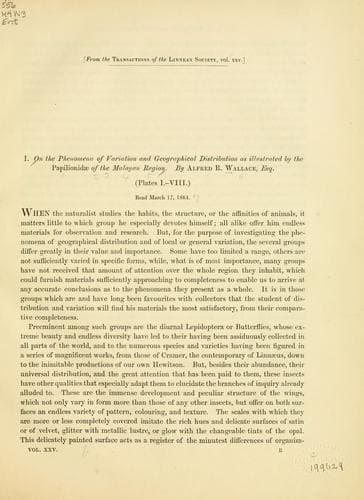
On the phenomena of variation and geographical distribution as illustrated by the Papilionidæ of the Malayan regionWallace, Alfred Russel
Science
On the phenomena of variation and geographical distribution as illustrated by the Papilionidæ of the Malayan region
Wallace, Alfred Russel
Papilionidae -- Malaysia -- Geographical distribution; Papilionidae -- Malaysia -- Variation
_Male_: resembles _O. Criton_ in the form and extent of the yellow
patch, but the upper wings differ in having the outer half of a lighter
tint; on the under surface this outer half of the wing is of a light
ash-colour. Abdomen almost wholly black beneath. No red patches at the
base of the wings, or any red collar.
_Female_ unknown.
_Hab._ Timor (_Wall._).
This is a very distinct species, though at first sight resembling
several others. I obtained a single male specimen only.
14. ORNITHOPTERA HALIPHRON, Boisduval.
_O. Haliphron_, Bd. Sp. Gén. Lép. p. 181 (♂); Felder, Lep. Fragm. p.
37, Taf. ii. f. 2, 3 (♂, ♀).
_Hab._ Macassar (Celebes) (_Wall._).
15. ORNITHOPTERA AMPHRISIUS, Cramer.
_P. Amphrisius_, Cr. Pap. Ex. t. 219. f. A; Godardt, Enc. Méth. ix. p.
27, pt.
_O. Amphrisius_, Bd. Sp. Gén. Lép. p. 178.
_Hab._ Malacca, Java, Borneo (_Wall._).
This may be readily distinguished from the allied species by the upper
wings in the male being yellow-marked, and by the absence of red spots
at the base of the wings beneath in both sexes.
c. _Brookeana_ group.
16. ORNITHOPTERA BROOKEANA, Wallace.
_O. Brookeana_, Wall. Proc. Ent. Soc. 1855, p. 104; Hewitson, Ex.
Butt. Papilionidæ, i. f. 1. _Papilio Trogon_, V. Voll. Tijdschrift
voor Ent. 1860, p. 69, pl. 6.
_Hab._ Borneo (Sarawak) (_Wall._), Sumatra (_Leyden Museum_).
_Remarks._—I have been in much doubt about the position of this
remarkable species, and was for some time inclined to place it among the
Papilios. It agrees, however, far better with _Ornithoptera_ in the form
and stoutness of the wings, the long stout and curved antennæ, the red
collar and patches at the base of the wings beneath, the abdominal fold,
and the flight and general appearance. It is powerful on the wing, and
occasionally settles on the ground in damp sunny places. It inhabits the
interior of North-west Borneo and the mountains of West Sumatra. The
female is unknown. It is peculiar in the great length of the discoidal
cell of the wings and its altogether unique style of coloration, and
must be considered as the type of a distinct group of the genus
_Ornithoptera_.
PAPILIO.
This is without doubt the finest and most remarkable genus of Diurnal
Lepidoptera. About 360 species are now known, all, except ten, being
tropical or subtropical. I have given at p. 23 the characters of the
sections and groups into which I divide the Malayan species.
SECTION A.
a. _Nox_ group.
17. PAPILIO NOX, Swainson.
_P. Nox._, Sw. Zool. Ill. pl. 102; Horsf. Lep. Ins. E. I. C. pl. 1. f.
1; Boisd. Sp. Gén. Lép. p. 277.
_P. Neesius_, Zink. Nov. Act. Acad. Nat. Cur. xv. t. 14. f. 1.
_Hab._ Java (♂, ♀) (_Wall._), Penang (♂) (_Brit. Mus._).
18. PAPILIO NOCTIS, Hewitson. Tab. V. fig. 1 (♂)[12].
Footnote 12:
Public-domain text, read in full here on John Shaqi.
Reviews
Reviews
No reviews yet
Be the first to share your thoughts on this work.
Elsewhere in the archive
Join the Discussion
Join the discussion
Sign in to leave a comment or review.
Sign InorCreate an account