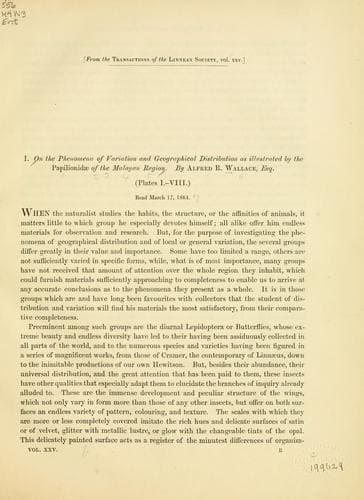
On the phenomena of variation and geographical distribution as illustrated by the Papilionidæ of the Malayan regionWallace, Alfred Russel
Science
On the phenomena of variation and geographical distribution as illustrated by the Papilionidæ of the Malayan region
Wallace, Alfred Russel
Papilionidae -- Malaysia -- Geographical distribution; Papilionidae -- Malaysia -- Variation
Above, black; macular band rich blue, very narrow, the spots on the
upper wings all more or less rounded and separated by thick black bands;
the marginal lunules large and angularly bent.
Beneath, the upper wings have a row of four pearly-white lunules from
the outer angle; and there is one of the same colour at the outer angle
of the lower wings, which have also an additional red spot on the margin
of the cell, below the first branch of the subcostal nervure. Expanse of
wings 4¾ inches.
_Hab._ Macassar and Menado (Celebes) (_Wall._).
_Remarks._—I have separated this species from all the other forms of _P.
Sarpedon_, because, while they differ in markings and colour only, this
differs greatly in form as well as very strikingly in size, colour, and
markings. I cannot conceive, therefore, why such a combination of
distinctive peculiarities should not entitle it to specific rank.
112. PAPILIO WALLACEI, Hewitson.
_P. Wallacei_, Hew. Ex. Butt., “Papilio,” iii. f. 7.
_Hab._ Aru Islands, Batchian (_Wall._).
_Remark._—This isolated species is very rare: I obtained a single male
specimen in each of the above localities in the virgin forest.
113. PAPILIO BATHYCLES, Zinken.
_P. Bathycles_, Zink. Beitr. Ins. Java, p. 157, tab. 14. f. 6, 7;
Boisd. Sp. Gén. Lép. p. 232.
_Hab._ Java, Borneo, Malacca (_Wall._).
_Remark._—The Indian form generally confounded with this I consider to
be a very distinct species, for which I propose the name of _P. Chiron_,
and add a description below[15].
Footnote 15:
PAPILIO CHIRON, n. s.
_P. Bathycles_ (partly), Brit. Mus. List of Papilionidæ.
Very near _P. Bathycles_, Zinken. Fore wings rather broader at the
tip; hind wings considerably less elongate posteriorly.
Above:—fore wings have the three larger green spots separated by broad
black spaces, the first produced towards the base of the wing, the
second notched above; the fourth spot in the cell much more linear.
Hind wings have the green markings more elongate and narrower, and an
additional narrow mark at the abdominal margin.
Beneath, the spots all separated by broad black lines; the abdominal
stripe, which is quite wanting in _P. Bathycles_, larger than above;
an ochre-yellow spot on the hind wings, near the base of the inner
margin (absent in _P. Bathycles_); the submarginal pale spots larger,
and the row of reddish-ochre spots less developed. Expanse of wings 3⅓
inches.
_Hab._ Assam, Sylhet.
114. PAPILIO EURYPYLUS, Linnæus.
_P. Eurypylus_, L.; Cram. Pap. Ex. t. 122. f. C, D; Boisd. Sp. Gén.
Lép. p. 233.
_Hab._ Amboyna (type), Ceram, Bouru, Batchian, New Guinea (_Wall._).
_Remark._—The _male_ has the abdomen above and abdominal margin white;
the _female_ blackish.
115. PAPILIO JASON, Esper.
_P. Jason_, Esp. Ausl. Schmett. t. 58. f. 5; _P. Jason_, L.? _P.
Eurypylus_, var., Boisd. Sp. Gén. Lép. p. 233.
_Hab._ Malacca, Sumatra, Borneo (♂, ♀) (_Wall._).
Public-domain text, read in full here on John Shaqi.
Reviews
Reviews
No reviews yet
Be the first to share your thoughts on this work.
Elsewhere in the archive
Join the Discussion
Join the discussion
Sign in to leave a comment or review.
Sign InorCreate an account