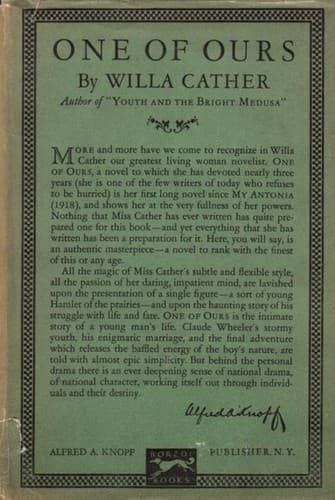
Farm life -- Fiction; Nebraska -- Fiction; Soldiers -- Fiction; War stories; World War, 1914-1918 -- Fiction
She closed the door, and he heard the lock slip. He stood looking
at the highly polished wood of the panel for a moment, then
turned irresolutely and went back along the slightly swaying
aisle of green curtains. In the observation car he stretched
himself out upon two wicker chairs and lit another cigar. At
twelve o'clock the porter came in.
"This car is closed for the night, sah. Is you the gen'leman from
the stateroom in fourteen? Do you want a lower?"
"No, thank you. Is there a smoking car?"
"They is the day-coach smokah, but it ain't likely very clean at
this time o' night."
"That's all right. It's forward?" Claude absently handed him a
coin, and the porter conducted him to a very dirty car where the
floor was littered with newspapers and cigar stumps, and the
leather cushions were grey with dust. A few desperate looking men
lay about with their shoes off and their suspenders hanging down
their backs. The sight of them reminded Claude that his left foot
was very sore, and that his shoes must have been hurting him for
some time. He pulled them off, and thrust his feet, in their silk
socks, on the opposite seat.
On that long, dirty, uncomfortable ride Claude felt many things,
but the paramount feeling was homesickness. His hurt was of a
kind that made him turn with a sort of aching cowardice to the
old, familiar things that were as sure as the sunrise. If only
the sagebrush plain, over which the stars were shining, could
suddenly break up and resolve itself into the windings of Lovely
Creek, with his father's house on the hill, dark and silent in
the summer night! When he closed his eyes he could see the light
in his mother's window; and, lower down, the glow of Mahailey's
lamp, where she sat nodding and mending his old shirts. Human
love was a wonderful thing, he told himself, and it was most
wonderful where it had least to gain.
By morning the storm of anger, disappointment, and humiliation
that was boiling in him when he first sat down in the observation
car, had died out. One thing lingered; the peculiarly casual,
indifferent, uninterested tone of his wife's voice when she sent
him away. It was the flat tone in which people make commonplace
remarks about common things.
Day broke with silvery brightness on the summer sage. The sky
grew pink, the sand grew gold. The dawn-wind brought through the
windows the acrid smell of the sagebrush: an odour that is
peculiarly stimulating in the early morning, when it always seems
to promise freedom... large spaces, new beginnings, better
days.
The train was due in Denver at eight o'clock. Exactly at seven
thirty Claude knocked at Enid's door,--this time firmly. She was
dressed, and greeted him with a fresh, smiling face, holding her
hat in her hand.
"Are you feeling better?" he asked.
"Oh, yes! I am perfectly all right this morning. I've put out all
your things for you, there on the seat."
He glanced at them. "Thank you. But I won't have time to change,
I'm afraid."
Public-domain text, read in full here on John Shaqi.
Reviews
Reviews
No reviews yet
Be the first to share your thoughts on this work.
Elsewhere in the archive
Join the Discussion
Join the discussion
Sign in to leave a comment or review.
Sign InorCreate an account