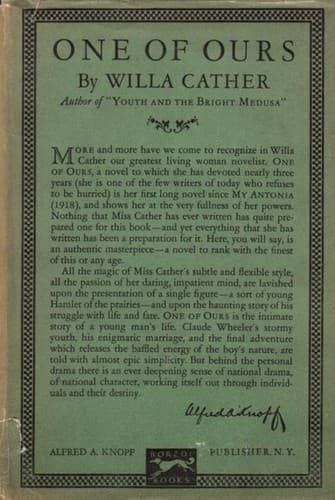
Farm life -- Fiction; Nebraska -- Fiction; Soldiers -- Fiction; War stories; World War, 1914-1918 -- Fiction
From time to time, when they were working together, Mrs. Wheeler
told Mahailey what she knew about the customs of the Chinese. The
old woman had never had two impersonal interests at the same time
before, and she scarcely knew what to do with them. She would
murmur on, half to Claude and half to herself: "They ain't
fightin' over there where Miss Enid is, is they? An' she won't
have to wear their kind of clothes, cause she's a white woman.
She won't let 'em kill their girl babies nor do such awful things
like they always have, an' she won't let 'em pray to them stone
iboles, cause they can't help 'em none. I 'spect Miss Enid'll do
a heap of good, all the time."
Behind her diplomatic monologues, however, Mahailey had her own
ideas, and she was greatly scandalized at Enid's departure. She
was afraid people would say that Claude's wife had "run off an'
lef' him," and in the Virginia mountains, where her social
standards had been formed, a husband or wife thus deserted was
the object of boisterous ridicule. She once stopped Mrs. Wheeler
in a dark corner of the cellar to whisper, "Mr. Claude's wife
ain't goin' to stay off there, like her sister, is she?"
If one of the Yoeder boys or Susie Dawson happened to be at the
Wheelers' for dinner, Mahailey never failed to refer to Enid in a
loud voice. "Mr. Claude's wife, she cuts her potatoes up raw in
the pan an' fries 'em. She don't boil 'em first like I do. I know
she's an awful good cook, I know she is." She felt that easy
references to the absent wife made things look better.
Ernest Havel came to see Claude now, but not often. They both
felt it would be indelicate to renew their former intimacy.
Ernest still felt aggrieved about his beer, as if Enid had
snatched the tankard from his lips with her own corrective hand.
Like Leonard, he believed that Claude had made a bad bargain in
matrimony; but instead of feeling sorry for him, Ernest wanted to
see him convinced and punished. When he married Enid, Claude had
been false to liberal principles, and it was only right that he
should pay for his apostasy. The very first time he came to spend
an evening at the Wheelers' after Claude came home to live,
Ernest undertook to explain his objections to Prohibition. Claude
shrugged his shoulders.
"Why not drop it? It's a matter that doesn't interest me, one way
or the other."
Ernest was offended and did not come back for nearly a
month--not, indeed, until the announcement that Germany would
resume unrestricted submarine warfare made every one look
questioningly at his neighbour.
He walked into the Wheelers' kitchen the night after this news
reached the farming country, and found Claude and his mother
sitting at the table, reading the papers aloud to each other in
snatches. Ernest had scarcely taken a seat when the telephone
bell rang. Claude answered the call.
Public-domain text, read in full here on John Shaqi.
Reviews
Reviews
No reviews yet
Be the first to share your thoughts on this work.
Elsewhere in the archive
Join the Discussion
Join the discussion
Sign in to leave a comment or review.
Sign InorCreate an account