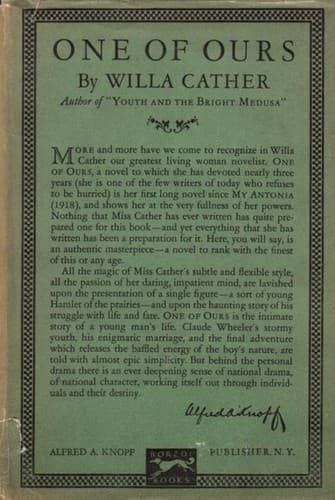
Farm life -- Fiction; Nebraska -- Fiction; Soldiers -- Fiction; War stories; World War, 1914-1918 -- Fiction
On the first day of July Claude Wheeler found himself in the fast
train from Omaha, going home for a week's leave. The uniform was
still an unfamiliar sight in July, 1917. The first draft was not
yet called, and the boys who had rushed off and enlisted were in
training camps far away. Therefore a redheaded young man with
long straight legs in puttees, and broad, energetic,
responsible-looking shoulders in close-fitting khaki, made a
conspicuous figure among the passengers. Little boys and young
girls peered at him over the tops of seats, men stopped in the
aisle to talk to him, old ladies put on their glasses and studied
his clothes, his bulky canvas hold-all, and even the book he kept
opening and forgetting to read.
The country that rushed by him on each side of the track was more
interesting to his trained eye than the pages of any book. He was
glad to be going through it at harvest,--the season when it is
most itself. He noted that there was more corn than usual,--much
of the winter wheat had been weather killed, and the fields were
ploughed up in the spring and replanted in maize. The pastures
were already burned brown, the alfalfa was coming green again
after its first cutting. Binders and harvesters were abroad in
the wheat and oats, gathering the soft-breathing billows of grain
into wide, subduing arms. When the train slowed down for a
trestle in a wheat field, harvesters in blue shirts and overalls
and wide straw hats stopped working to wave at the passengers.
Claude turned to the old man in the opposite seat. "When I see
those fellows, I feel as if I'd wakened up in the wrong clothes."
His neighbour looked pleased and smiled. "That the kind of
uniform you're accustomed to?"
"I surely never wore anything else in the month of July," Claude
admitted. "When I find myself riding along in a train, in the
middle of harvest, trying to learn French verbs, then I know the
world is turned upside down, for a fact!"
The old man pressed a cigar upon him and began to question him.
Like the hero of the Odyssey upon his homeward journey, Claude
had often to tell what his country was, and who were the parents
that begot him. He was constantly interrupted in his perusal of a
French phrase-book (made up of sentences chosen for their
usefulness to soldiers,--such as; "Non, jamais je ne regarde les
femmes") by the questions of curious strangers. Presently he
gathered up his luggage, shook hands with his neighbour, and put
on his hat--the same old Stetson, with a gold cord and two hard
tassels added to its conical severity. "I get off at this station
and wait for the freight that goes down to Frankfort; the
cotton-tail, we call it."
Public-domain text, read in full here on John Shaqi.
Reviews
Reviews
No reviews yet
Be the first to share your thoughts on this work.
Elsewhere in the archive
Join the Discussion
Join the discussion
Sign in to leave a comment or review.
Sign InorCreate an account