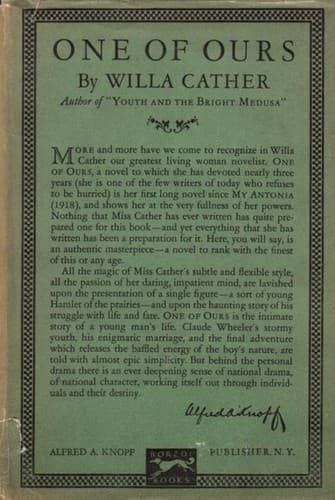
Farm life -- Fiction; Nebraska -- Fiction; Soldiers -- Fiction; War stories; World War, 1914-1918 -- Fiction
As the troop ship glided down the sea lane, the old man still
watched it from the turtle-back. That howling swarm of brown arms
and hats and faces looked like nothing, but a crowd of American
boys going to a football game somewhere. But the scene was
ageless; youths were sailing away to die for an idea, a
sentiment, for the mere sound of a phrase... and on their
departure they were making vows to a bronze image in the sea.
III
All the first morning Tod Fanning showed Claude over the
boat,--not that Fanning had ever been on anything bigger than a
Lake Michigan steamer, but he knew a good deal about machinery,
and did not hesitate to ask the deck stewards to explain anything
he didn't know. The stewards, indeed all the crew, struck the
boys as an unusually good-natured and obliging set of men.
The fourth occupant of number 96, Claude's cabin, had not turned
up by noon, nor had any of his belongings, so the three who had
settled their few effects there began to hope they would have the
place to themselves. It would be crowded enough, at that. The
third bunk was assigned to an officer from the Kansas regiment,
Lieutenant Bird, a Virginian, who had been working in his uncle's
bank in Topeka when he enlisted. He and Claude sat together at
mess. When they were at lunch, the Virginian said in his very
gentle voice:
"Lieutenant, I wish you'd explain Lieutenant Fanning to me. He
seems very immature. He's been telling me about a submarine
destroyer he's invented, but it looks to me like foolishness."
Claude laughed. "Don't try to understand Fanning. Just let him
sink in, and you'll come to like him. I used to wonder how he
ever got a commission. You never can tell what crazy thing he'll
do."
Fanning had, for instance, brought on board a pair of white
flannel pants, his first and only tailor-made trousers, because
he had a premonition that the boat would make a port and that he
would be asked to a garden party! He had a way of using big words
in the wrong place, not because he tried to show off, but because
all words sounded alike to him. In the first days of their
acquaintance in camp he told Claude that this was a failing he
couldn't help, and that it was called "anaesthesia." Sometimes
this failing was confusing; when Fanning sententiously declared
that he would like to be on hand when the Crown Prince settled
his little account with Plato, Claude was perplexed until
subsequent witticisms revealed that the boy meant Pluto.
Public-domain text, read in full here on John Shaqi.
Reviews
Reviews
No reviews yet
Be the first to share your thoughts on this work.
Elsewhere in the archive
Join the Discussion
Join the discussion
Sign in to leave a comment or review.
Sign InorCreate an account