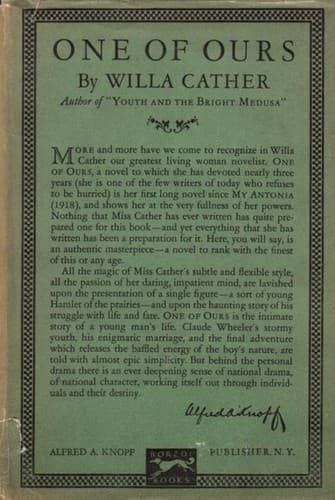
Farm life -- Fiction; Nebraska -- Fiction; Soldiers -- Fiction; War stories; World War, 1914-1918 -- Fiction
Something was released that had been struggling for a long while,
he told himself. He had been due in France since the first battle
of the Marne; he had followed false leads and lost precious time
and seen misery enough, but he was on the right road at last, and
nothing could stop him. If he hadn't been so green, so bashful,
so afraid of showing what he felt, and so stupid at finding his
way about, he would have enlisted in Canada, like Victor, or run
away to France and joined the Foreign Legion. All that seemed
perfectly possible now. Why hadn't he?
Well, that was not "the Wheelers' way." The Wheelers were
terribly afraid of poking themselves in where they weren't
wanted, of pushing their way into a crowd where they didn't
belong. And they were even more afraid of doing anything that
might look affected or "romantic." They couldn't let themselves
adopt a conspicuous, much less a picturesque course of action,
unless it was all in the day's work. Well, History had
condescended to such as he; this whole brilliant adventure had
become the day's work. He had got into it after all, along with
Victor and the Marine and other fellows who had more imagination
and self-confidence in the first place. Three years ago he used
to sit moping by the windmill because he didn't see how a
Nebraska farmer boy had any "call," or, indeed, any way, to throw
himself into the struggle in France. He used enviously to read
about Alan Seeger and those fortunate American boys who had a
right to fight for a civilization they knew.
But the miracle had happened; a miracle so wide in its amplitude
that the Wheelers,--all the Wheelers and the roughnecks and the
low-brows were caught up in it. Yes, it was the rough-necks' own
miracle, all this; it was their golden chance. He was in on it,
and nothing could hinder or discourage him unless he were put
over the side himself--which was only a way of joking, for that
was a possibility he never seriously considered. The feeling of
purpose, of fateful purpose, was strong in his breast.
IX
"Look at this, Doctor!" Claude caught Dr. Trueman on his way from
breakfast and handed him a written notice, signed D. T. Micks,
Chief Steward. It stated that no more eggs or oranges could be
furnished to patients, as the supply was exhausted.
The doctor squinted at the paper. "I'm afraid that's your
patient's death warrant. You'll never be able to keep him going
on anything else. Why don't you go and talk it over with Chessup?
He's a resourceful fellow. I'll join you there in a few minutes."
Public-domain text, read in full here on John Shaqi.
Reviews
Reviews
No reviews yet
Be the first to share your thoughts on this work.
Elsewhere in the archive
Join the Discussion
Join the discussion
Sign in to leave a comment or review.
Sign InorCreate an account