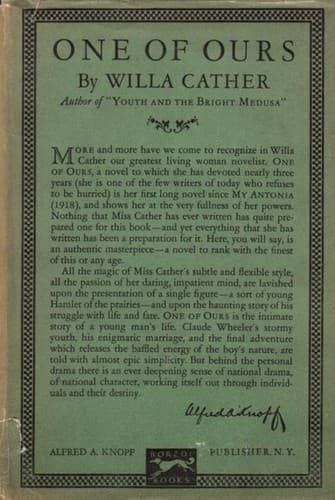
Farm life -- Fiction; Nebraska -- Fiction; Soldiers -- Fiction; War stories; World War, 1914-1918 -- Fiction
Standing in her doorway, she watched the brown band go ambling
down the street; as they passed in front of the old church of St.
Jacques, the two foremost stumbled on a sunken step that was
scarcely above the level of the pavement. She laughed aloud. They
looked back and waved to her. She replied with a smile that was
both friendly and angry. She liked them, but not the legend of
waste and prodigality that ran before them--and followed after.
It was superfluous and disintegrating in a world of hard facts.
An army in which the men had meat for breakfast, and ate more
every day than the French soldiers at the front got in a week!
Their moving kitchens and supply trains were the wonder of
France. Down below Arles, where her husband's sister had married,
on the desolate plain of the Crau, their tinned provisions were
piled like mountain ranges, under sheds and canvas. Nobody had
ever seen so much food before; coffee, milk, sugar, bacon, hams;
everything the world was famished for. They brought shiploads of
useless things, too. And useless people. Shiploads of women who
were not nurses; some said they came to dance with the officers,
so they would not be ennuyés.
All this was not war,--any more than having money thrust at you
by grown men who could not count, was business. It was an
invasion, like the other. The first destroyed material
possessions, and this threatened everybody's integrity. Distaste
of such methods, deep, recoiling distrust of them, clouded the
cheesewoman's brow as she threw her money into the drawer and
turned the key on it.
As for the doughboys, having once stubbed their toes on the
sunken step, they examined it with interest, and went in to
explore the church. It was in their minds that they must not let
a church escape, any more than they would let a Boche escape.
Within they came upon a bunch of their shipmates, including the
Kansas band, to whom they boasted that their Lieutenant could
"speak French like a native."
The Lieutenant himself thought he was getting on pretty well, but
a few hours later his pride was humbled. He was sitting alone in
a little triangular park beside another church, admiring the
cropped locust trees and watching some old women who were doing
their mending in the shade. A little boy in a black apron, with a
close-shaved, bare head, came along, skipping rope. He hopped
lightly up to Claude and said in a most persuasive and confiding
voice,
"Voulez-vous me dire l'heure, s'il vous plaît, M'sieu' l'
soldat?"
Claude looked down into his admiring eyes with a feeling of
panic. He wouldn't mind being dumb to a man, or even to a pretty
girl, but this was terrible. His tongue went dry, and his face
grew scarlet. The child's expectant gaze changed to a look of
doubt, and then of fear. He had spoken before to Americans who
didn't understand, but they had not turned red and looked angry
like this one; this soldier must be ill, or wrong in his head.
The boy turned and ran away.
Public-domain text, read in full here on John Shaqi.
Reviews
Reviews
No reviews yet
Be the first to share your thoughts on this work.
Elsewhere in the archive
Join the Discussion
Join the discussion
Sign in to leave a comment or review.
Sign InorCreate an account