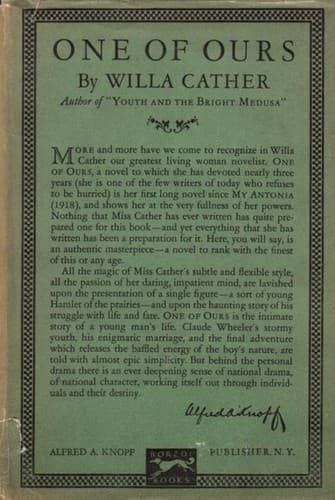
Farm life -- Fiction; Nebraska -- Fiction; Soldiers -- Fiction; War stories; World War, 1914-1918 -- Fiction
The entrance to the nave was closed by a cord, so he walked up
the aisle on the right, treading softly, passing chapels where
solitary women knelt in the light of a few tapers. Except for
them, the church was empty... empty. His own breathing was
audible in this silence. He moved with caution lest he should
wake an echo.
When he reached the choir he turned, and saw, far behind him, the
rose window, with its purple heart. As he stood staring, hat in
hand, as still as the stone figures in the chapels, a great bell,
up aloft, began to strike the hour in its deep, melodious throat;
eleven beats, measured and far apart, as rich as the colours in
the window, then silence... only in his memory the throbbing
of an undreamed-of quality of sound. The revelations of the glass
and the bell had come almost simultaneously, as if one produced
the other; and both were superlatives toward which his mind had
always been groping,--or so it seemed to him then.
In front of the choir the nave was open, with no rope to shut it
off. Several straw chairs were huddled on a flag of the stone
floor. After some hesitation he took one, turned it round, and
sat down facing the window. If some one should come up to him and
say anything, anything at all, he would rise and say, "Pardon,
Monsieur; je ne sais pas c'est defendu." He repeated this to
himself to be quite sure he had it ready.
On the train, coming down, he had talked to the boys about the
bad reputation Americans had acquired for slouching all over the
place and butting in on things, and had urged them to tread
lightly, "But Lieutenant," the kid from Pleasantville had piped
up, "isn't this whole Expedition a butt-in? After all, it ain't
our war." Claude laughed, but he told him he meant to make an
example of the fellow who went to rough-housing.
He was well satisfied that he hadn't his restless companions on
his mind now. He could sit here quietly until noon, and hear the
bell strike again. In the meantime, he must try to think: This
was, of course, Gothic architecture; he had read more or less
about that, and ought to be able to remember something. Gothic...
that was a mere word; to him it suggested something very
peaked and pointed,--sharp arches, steep roofs. It had nothing to
do with these slim white columns that rose so straight and
far,--or with the window, burning up there in its vault of
gloom....
Public-domain text, read in full here on John Shaqi.
Reviews
Reviews
No reviews yet
Be the first to share your thoughts on this work.
Elsewhere in the archive
Join the Discussion
Join the discussion
Sign in to leave a comment or review.
Sign InorCreate an account