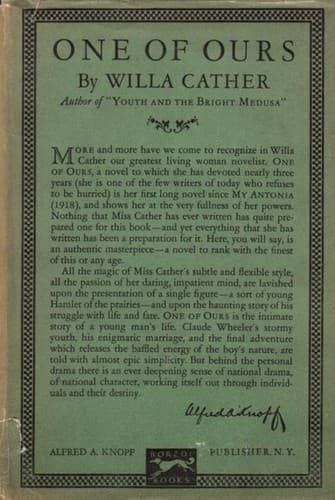
Farm life -- Fiction; Nebraska -- Fiction; Soldiers -- Fiction; War stories; World War, 1914-1918 -- Fiction
"I see you're an officer short, Captain Maxey," the Colonel
remarked at their conference. "I think I've got a man here to
take his place. Lieutenant Gerhardt is a New York man, came over
in the band and got transferred to infantry. He has lately been
given a commission for good service. He's had some experience and
is a capable fellow." The Colonel sent his orderly out to bring
in a young man whom he introduced to the officers as Lieutenant
David Gerhardt.
Claude had been ashamed of Tod Fanning, who was always showing
himself a sap-head, and who would never have got a commission if
his uncle hadn't been a Congressman. But the moment he met
Lieutenant Gerhardt's eye, something like jealousy flamed up in
him. He felt in a flash that he suffered by comparison with the
new officer; that he must be on his guard and must not let
himself be patronized.
As they were leaving the Colonel's office together, Gerhardt
asked him whether he had got his billet. Claude replied that
after the men were in their quarters, he would look out for
something for himself.
The young man smiled. "I'm afraid you may have difficulty. The
people about here have been overworked, keeping soldiers, and
they are not willing as they once were. I'm with a nice old
couple over in the village. I'm almost sure I can get you in
there. If you'll come along, we'll speak to them, before some one
else is put off on them."
Claude didn't want to go, didn't want to accept
favours,--nevertheless he went. They walked together along a
dusty road that ran between half-ripe wheat fields, bordered with
poplar trees. The wild morning-glories and Queen Anne's lace that
grew by the road-side were still shining with dew. A fresh breeze
stirred the bearded grain, parting it in furrows and fanning out
streaks of crimson poppies. The new officer was not intrusive,
certainly. He walked along, whistling softly to himself, seeming
quite lost in the freshness of the morning, or in his own
thoughts. There had been nothing patronizing in his manner so
far, and Claude began to wonder why he felt ill at ease with him.
Perhaps it was because he did not look like the rest of them.
Though he was young, he did not look boyish. He seemed
experienced; a finished product, rather than something on the
way. He was handsome, and his face, like his manner and his walk,
had something distinguished about it. A broad white forehead
under reddish brown hair, hazel eyes with no uncertainty in their
look, an aquiline nose, finely cut,--a sensitive, scornful mouth,
which somehow did not detract from the kindly, though slightly
reserved, expression of his face.
Lieutenant Gerhardt must have been in this neighbourhood for some
time; he seemed to know the people. On the road they passed
several villagers; a rough looking girl taking a cow out to graze,
an old man with a basket on his arm, the postman on his bicycle;
they all spoke to Claude's companion as if they knew him well.
Public-domain text, read in full here on John Shaqi.
Reviews
Reviews
No reviews yet
Be the first to share your thoughts on this work.
Elsewhere in the archive
Join the Discussion
Join the discussion
Sign in to leave a comment or review.
Sign InorCreate an account