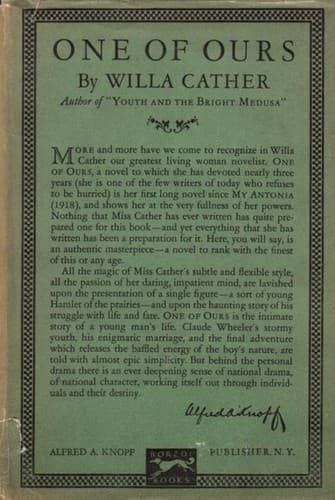
Farm life -- Fiction; Nebraska -- Fiction; Soldiers -- Fiction; War stories; World War, 1914-1918 -- Fiction
"There's not much to do here, by way of amusement," said the
Major. "A movie show tonight, and you can get anything you want
at the estaminet,--the one on the square, opposite the English
tank, is the best. There are a couple of nice Frenchwomen in the
Red Cross barrack, up on the hill, in the old convent garden.
They try to look out for the civilian population, and we're on
good terms with them. We get their supplies through with our own,
and the quartermaster has orders to help them when they run
short. You might go up and call on them. They speak English
perfectly."
Claude asked whether he could walk in on them without any kind of
introduction.
"Oh, yes, they're used to us! I'll give you a card to Mlle.
Olive, though. She's a particular friend of mine. There you are:
'Mlle. Olive de Courcy, introducing, etc.' And, you understand,"
here he glanced up and looked Claude over from head to foot,
"she's a perfect lady."
Even with an introduction, Claude felt some hesitancy about
presenting himself to these ladies. Perhaps they didn't like
Americans; he was always afraid of meeting French people who
didn't. It was the same way with most of the fellows in his
battalion, he had found; they were terribly afraid of being
disliked. And the moment they felt they were disliked, they
hastened to behave as badly as possible, in order to deserve it;
then they didn't feel that they had been taken in--the worst
feeling a doughboy could possibly have!
Claude thought he would stroll about to look at the town a
little. It had been taken by the Germans in the autumn of 1914,
after their retreat from the Marne, and they had held it until
about a year ago, when it was retaken by the English and the
Chasseurs d'Alpins. They had been able to reduce it and to drive
the Germans out, only by battering it down with artillery; not
one building remained standing.
Ruin was ugly, and it was nothing more, Claude was thinking, as
he followed the paths that ran over piles of brick and plaster.
There was nothing picturesque about this, as there was in the war
pictures one saw at home. A cyclone or a fire might have done
just as good a job. The place was simply a great dump-heap; an
exaggeration of those which disgrace the outskirts of American
towns. It was the same thing over and over; mounds of burned
brick and broken stone, heaps of rusty, twisted iron, splintered
beams and rafters, stagnant pools, cellar holes full of muddy
water. An American soldier had stepped into one of those holes a
few nights before, and been drowned.
Public-domain text, read in full here on John Shaqi.
Reviews
Reviews
No reviews yet
Be the first to share your thoughts on this work.
Elsewhere in the archive
Join the Discussion
Join the discussion
Sign in to leave a comment or review.
Sign InorCreate an account