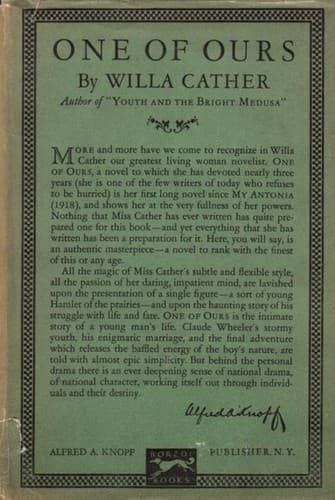
Farm life -- Fiction; Nebraska -- Fiction; Soldiers -- Fiction; War stories; World War, 1914-1918 -- Fiction
She smiled. "I do not think there are any French girls left.
There are children and women. I was twenty-one when the war came,
and I had never been anywhere without my mother or my brother or
sister. Within a year I went all over France alone; with
soldiers, with Senegalese, with anybody. Everything is different
with us." She lived at Versailles, she told him, where her father
had been an instructor in the Military School. He had died since
the beginning of the war. Her grandfather was killed in the war
of 1870. Hers was a family of soldiers, but not one of the men
would be left to see the day of victory.
She looked so tired that Claude knew he had no right to stay.
Long shadows were falling in the garden. It was hard to leave;
but an hour more or less wouldn't matter. Two people could hardly
give each other more if they were together for years, he thought.
"Will you tell me where I can come and see you, if we both get
through this war?" he asked as he rose.
He wrote it down in his notebook.
"I shall look for you," she said, giving him her hand.
There was nothing to do but to take his helmet and go. At the
edge of the hill, just before he plunged down the path, he
stopped and glanced back at the garden lying flattened in the
sun; the three stone arches, the dahlias and marigolds, the
glistening boxwood wall. He had left something on the hilltop
which he would never find again.
The next afternoon Claude and his sergeant set off for the front.
They had been told at Headquarters that they could shorten their
route by following the big road to the military cemetery, and
then turning to the left. It was not advisable to go the latter
half of the way before nightfall, so they took their time through
the belt of straggling crops and hayfields.
When they struck the road they came upon a big Highlander sitting
in the end of an empty supply wagon, smoking a pipe and rubbing
the dried mud out of his kilts. The horses were munching in their
nose-bags, and the driver had disappeared. The Americans hadn't
happened to meet with any Highlanders before, and were curious.
This one must be a good fighter, they thought; a brawny giant
with a bulldog jaw, and a face as red and knobby as his knees.
More because he admired the looks of the man than because he
needed information, Hicks went up and asked him if he had noticed
a military cemetery on the road back. The Kilt nodded.
"About how far back would you say it was?"
"I wouldn't say at all. I take no account of their kilometers,"
he replied dryly, rubbing away at his skirt as if he had it in a
washtub.
"Well, about how long will it take us to walk it?"
"That I couldn't say. A Scotsman would do it in an hour."
"I guess a Yankee can do it as quick as a Scotchman, can't be?"
Hicks asked jovially.
"That I couldn't say. You've been four years gettin' this far, I
know verra well."
Hicks blinked as if he had been hit. "Oh, if that's the way you
talk--"
"That's the way I do," said the other sourly.
Public-domain text, read in full here on John Shaqi.
Reviews
Reviews
No reviews yet
Be the first to share your thoughts on this work.
Elsewhere in the archive
Join the Discussion
Join the discussion
Sign in to leave a comment or review.
Sign InorCreate an account