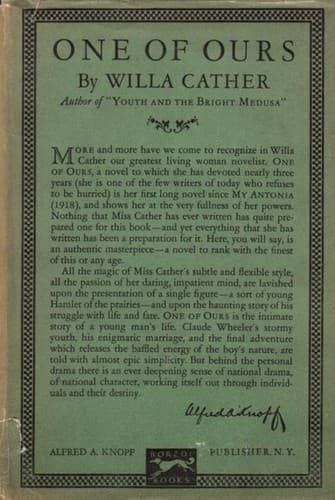
Farm life -- Fiction; Nebraska -- Fiction; Soldiers -- Fiction; War stories; World War, 1914-1918 -- Fiction
companion stirred and rolled over on his elbow.
"You know we are to join the Battalion at A--. They'll be living
like kings there. Hicks will get so fat he'll drop over on the
march. Headquarters must have something particularly nasty in
mind; the infantry is always fed up before a slaughter. But I've
been thinking; I have some old friends at A--. Suppose we go on
there a day early, and get them to take us in? It's a fine old
place, and I ought to go to see them. The son was a fellow
student of mine at the Conservatoire. He was killed the second
winter of the war. I used to go up there for the holidays with
him; I would like to see his mother and sister again. You've no
objection?"
Claude did not answer at once. He lay squinting off at the beech
trees, without moving. "You always avoid that subject with me,
don't you?" he said presently.
"What subject?"
"Oh, anything to do with the Conservatoire, or your profession."
"I haven't any profession at present. I'll never go back to the
violin."
"You mean you couldn't make up for the time you'll lose?"
Gerhardt settled his back against a rock and got out his pipe.
"That would be difficult; but other things would be harder. I've
lost much more than time."
"Couldn't you have got exemption, one way or another?"
"I might have. My friends wanted to take it up and make a test
case of me. But I couldn't stand for it. I didn't feel I was a
good enough violinist to admit that I wasn't a man. I often wish
I had been in Paris that summer when the war broke out; then I
would have gone into the French army on the first impulse, with
the other students, and it would have been better."
David paused and sat puffing at his pipe. Just then a soft
movement stirred the brakes on the hillside. A little barefoot
girl stood there, looking about. She had heard voices, but at
first did not see the uniforms that blended with the yellow and
brown of the wood. Then she saw the sun shining on two heads; one
square, and amber in colour,--the other reddish bronze, long and
narrow. She took their friendliness for granted and came down the
hill, stopping now and again to pick up shiny horse chestnuts and
pop them into a sack she was dragging. David called to her and
asked her whether the nuts were good to eat.
"Oh, non!" she exclaimed, her face expressing the liveliest
terror, "pour les cochons!" These inexperienced Americans might
eat almost anything. The boys laughed and gave her some pennies,
"pour les cochons aussi." She stole about the edge of the wood,
stirring among the leaves for nuts, and watching the two
soldiers.
Public-domain text, read in full here on John Shaqi.
Reviews
Reviews
No reviews yet
Be the first to share your thoughts on this work.
Elsewhere in the archive
Join the Discussion
Join the discussion
Sign in to leave a comment or review.
Sign InorCreate an account