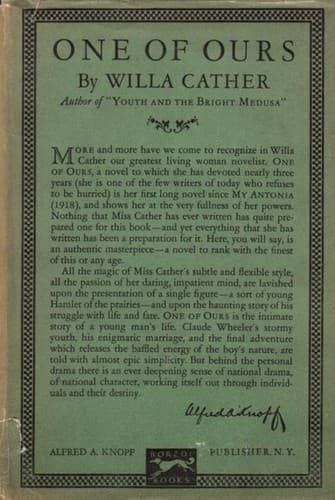
Farm life -- Fiction; Nebraska -- Fiction; Soldiers -- Fiction; War stories; World War, 1914-1918 -- Fiction
"I don't believe it." Claude stopped for a moment by the edge of
the fountain, trying to collect his thoughts. "I don't believe it
has killed anything. It has only scattered things." He glanced
about hurriedly at the sleeping house, the sleeping garden, the
clear, starry sky not very far overhead. "It's men like you that
get the worst of it," he broke out. "But as for me, I never knew
there was anything worth living for, till this war came on.
Before that, the world seemed like a business proposition."
"You'll admit it's a costly way of providing adventure for the
young," said David drily.
"Maybe so; all the same..."
Claude pursued the argument to himself long after they were in
their luxurious beds and David was asleep. No battlefield or
shattered country he had seen was as ugly as this world would be
if men like his brother Bayliss controlled it altogether. Until
the war broke out, he had supposed they did control it; his
boyhood had been clouded and enervated by that belief. The
Prussians had believed it, too, apparently. But the event had
shown that there were a great many people left who cared about
something else.
The intervals of the distant artillery fire grew shorter, as if
the big guns were tuning up, choking to get something out. Claude
sat up in his bed and listened. The sound of the guns had from
the first been pleasant to him, had given him a feeling of
confidence and safety; tonight he knew why. What they said was,
that men could still die for an idea; and would burn all they had
made to keep their dreams. He knew the future of the world was
safe; the careful planners would never be able to put it into a
strait-jacket,--cunning and prudence would never have it to
themselves. Why, that little boy downstairs, with the candlelight
in his eyes, when it came to the last cry, as they said, could
"carry on" for ever! Ideals were not archaic things, beautiful
and impotent; they were the real sources of power among men. As
long as that was true, and now he knew it was true--he had come
all this way to find out--he had no quarrel with Destiny. Nor did
he envy David. He would give his own adventure for no man's. On
the edge of sleep it seemed to glimmer, like the clear column of
the fountain, like the new moon,--alluring, half-averted, the
bright face of danger.
XV
When Claude and David rejoined their Battalion on the 20th of
September, the end of the war looked as far away as ever. The
collapse of Bulgaria was unknown to the American army, and their
acquaintance with European affairs was so slight that this would
have meant very little to them had they heard of it. The German
army still held the north and east of France, and no one could
say how much vitality was left in that sprawling body.
The Battalion entrained at Arras. Lieutenant Colonel Scott had
orders to proceed to the railhead, and then advance on foot into
the Argonne.
Public-domain text, read in full here on John Shaqi.
Reviews
Reviews
No reviews yet
Be the first to share your thoughts on this work.
Elsewhere in the archive
Join the Discussion
Join the discussion
Sign in to leave a comment or review.
Sign InorCreate an account