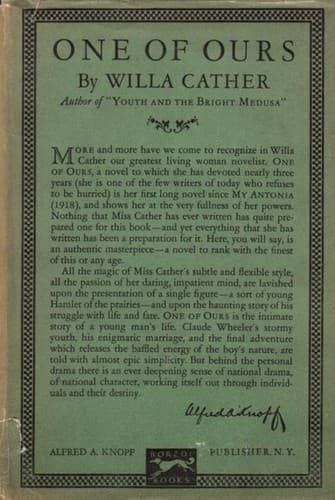
Farm life -- Fiction; Nebraska -- Fiction; Soldiers -- Fiction; War stories; World War, 1914-1918 -- Fiction
The right of the Hun line swerved out, not more than twenty yards
from the battered Snout, trying to run to shelter under that pile
of debris and human bodies. A quick concentration of rifle fire
depressed it, and the swell came out again toward the left.
Claude's appearance on the parapet had attracted no attention
from the enemy at first, but now the bullets began popping about
him; two rattled on his tin hat, one caught him in the shoulder.
The blood dripped down his coat, but he felt no weakness. He felt
only one thing; that he commanded wonderful men. When David came
up with the supports he might find them dead, but he would find
them all there. They were there to stay until they were carried
out to be buried. They were mortal, but they were unconquerable.
The Colonel's twenty minutes must be almost up, he thought. He
couldn't take his eyes from the front line long enough to look at
his wrist watch.... The men behind him saw Claude sway as if
he had lost his balance and were trying to recover it. Then he
plunged, face down, outside the parapet. Hicks caught his foot
and pulled him back. At the same moment the Missourians ran
yelling up the communication. They threw their machine guns up on
the sand bags and went into action without an unnecessary motion.
Hicks and Bert Fuller and Oscar carried Claude forward toward the
Snout, out of the way of the supports that were pouring in. He
was not bleeding very much. He smiled at them as if he were going
to speak, but there was a weak blankness in his eyes. Bert tore
his shirt open; three clean bullet holes. By the time they looked
at him again, the smile had gone... the look that was Claude
had faded. Hicks wiped the sweat and smoke from his officer's
face. "Thank God I never told him," he said. "Thank God for
that!"
Bert and Oscar knew what Hicks meant. Gerhardt had been blown to
pieces at his side when they dashed back through the enemy
barrage to find the Missourians. They were running together
across the open, not able to see much for smoke. They bumped into
a section of wire entanglement, left above an old trench. David
cut round to the right, waving Hicks to follow him. The two were
not ten yards apart when the shell struck. Then Sergeant Hicks
ran on alone.
XIX
The sun is sinking low, a transport is steaming slowly up the
narrows with the tide. The decks are covered with brown men. They
cluster over the superstructure like bees in swarming time. Their
attitudes are relaxed and lounging. Some look thoughtful, some
well contented, some are melancholy, and many are indifferent, as
they watch the shore approaching. They are not the same men who
went away.
Sergeant Hicks was standing in the stern, smoking, reflecting,
watching the twinkle of the red sunset upon the cloudy water. It
is more than a year since he sailed for France. The world has
changed in that time, and so has he.
Public-domain text, read in full here on John Shaqi.
Reviews
Reviews
No reviews yet
Be the first to share your thoughts on this work.
Elsewhere in the archive
Join the Discussion
Join the discussion
Sign in to leave a comment or review.
Sign InorCreate an account