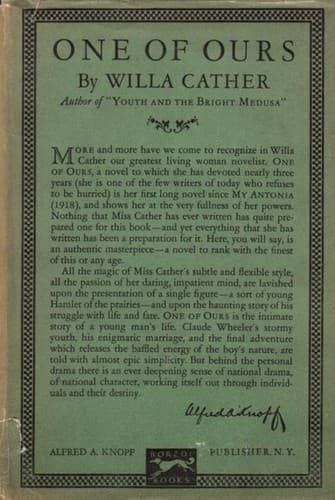
Farm life -- Fiction; Nebraska -- Fiction; Soldiers -- Fiction; War stories; World War, 1914-1918 -- Fiction
Claude shook his head slowly, as it lay against the back of the
chair. "No, it's not that. It's having so much time to think that
makes me blue. You see, Enid, I've never yet done anything that
gave me any satisfaction. I must be good for something. When I
lie still and think, I wonder whether my life has been happening
to me or to somebody else. It doesn't seem to have much
connection with me. I haven't made much of a start."
"But you are not twenty-two yet. You have plenty of time to
start. Is that what you are thinking about all the time!" She
shook her finger at him.
"I think about two things all the time. That is one of them."
Mrs. Wheeler came in with Claude's four o'clock milk; it was his
first day downstairs.
When they were children, playing by the mill-dam, Claude had seen
the future as a luminous vagueness in which he and Enid would
always do things together. Then there came a time when he wanted
to do everything with Ernest, when girls were disturbing and a
bother, and he pushed all that into the distance, knowing that
some day he must reckon with it again.
Now he told himself he had always known Enid would come back; and
she had come on that afternoon when she entered his drug-smelling
room and let in the sunlight. She would have done that for nobody
but him. She was not a girl who would depart lightly from
conventions that she recognized as authoritative. He remembered
her as she used to march up to the platform for Children's Day
exercises with the other little girls of the infant class; in her
stiff white dress, never a curl awry or a wrinkle in her
stocking, keeping her little comrades in order by the acquiescent
gravity of her face, which seemed to say, "How pleasant it is to
do thus and to do Right!"
Old Mr. Smith was the minister in those days,--a good man who had
been much tossed about by a stormy and temperamental wife--and his
eyes used to rest yearningly upon little Enid Royce, seeing in
her the promise of "virtuous and comely Christian womanhood," to
use one of his own phrases. Claude, in the boys' class across the
aisle, used to tease her and try to distract her, but he
respected her seriousness.
When they played together she was fair-minded, didn't whine if
she got hurt, and never claimed a girl's exemption from anything
unpleasant. She was calm, even on the day when she fell into the
mill-dam and he fished her out; as soon as she stopped choking
and coughing up muddy water, she wiped her face with her little
drenched petticoats, and sat shivering and saying over and over,
"Oh, Claude, Claude!" Incidents like that one now seemed to him
significant and fateful.
Public-domain text, read in full here on John Shaqi.
Reviews
Reviews
No reviews yet
Be the first to share your thoughts on this work.
Elsewhere in the archive
Join the Discussion
Join the discussion
Sign in to leave a comment or review.
Sign InorCreate an account