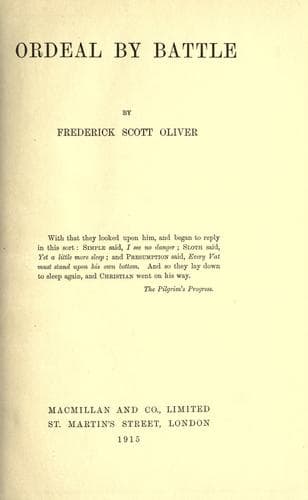
Draft -- Great Britain; Great Britain -- Defenses; World War, 1914-1918
It would be unfair to judge any country by its political professors.
At the same time, if any country is so foolish as to follow such
guides, there is a probability of mischief in national--still more in
international--affairs. For they are as innocent as the lawyers
themselves, of any knowledge of the real insides of things. They
differ of course from the lawyers in many ways. They are ever for
making changes for the sake of symmetry; while the man of law is for
keeping as he is until the last moment; or at any rate until it is
clearly his interest to budge. A priesthood has a burning faith in its
own hand-wrought idols; the lawyer on the contrary, does not go readily
to the stake, does not catch fire easily, being rather of the nature of
asbestos. When lawyers monopolise political power--even when they
merely {138} preponderate, as of late years they have seemed to do more
and more in all democratic countries, whether of the monarchical or
republican type--they invariably destroy by insensible gradations that
which is most worth preserving in man or state, the soul. But they do
not bring on sudden catastrophe as a priesthood does; their method is
to strangle slowly like ivy.
In England, nowadays--indeed ever since the 'eighties, when professors
of Political Economy became discredited as political guides--there are
not many evidences of priestly influence. Certainly there is nothing
of an organised kind. What exists is erratic and incalculable. There
is much clamour; but it is contradictory, spasmodic, and inconstant,
without any serious pretence, either of learning or science, to support
it. Each of our prophets is in business for himself. There is no
tinge of Erastianism about any of them. For the most part they are the
grotesques and _lions comiques_ of the world of letters, who prophesy
standing on their heads, or grinning through horse-collars, and
mistaking always "the twinkling of their own sophisticated minds for
wisdom."
Alliance between a priesthood and a bureaucracy tends gradually to
produce, as in the case of China, an oppressive uniformity--not unlike
that aimed at by the more advanced socialists--where every fresh
innovation is a restriction hampering the natural bent. On the other
hand an alliance between a priesthood and a military caste--especially
when the bureaucracy is ready to act in sympathy--is one of the
commonest causes of international convulsions.
{139}
[Sidenote: PRIESTS AND SOLDIERS]
Public-domain text, read in full here on John Shaqi.
Reviews
Reviews
No reviews yet
Be the first to share your thoughts on this work.
Elsewhere in the archive
Join the Discussion
Join the discussion
Sign in to leave a comment or review.
Sign InorCreate an account