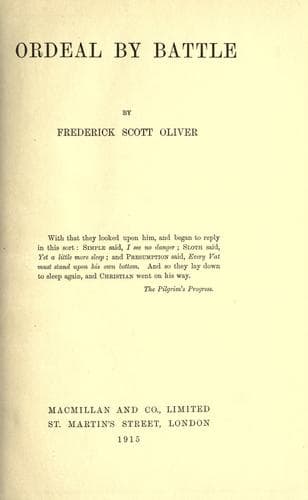
Draft -- Great Britain; Great Britain -- Defenses; World War, 1914-1918
"You cannot wonder if we Germans, and for that matter the whole world,
have drawn certain conclusions from these and other incidents. We do
not doubt that your ministers have acted wisely in suppressing bad
tidings; but why should they have taken all those pains and endured the
derision, while incurring the distrust, of foreign countries--a
material injury, mind you, and not merely a sentimental one--unless
they had known, only too well, that publication of this or that piece
of news would have too painfully affected the nerves of your people?
Concealment of checks, reverses, and disasters which had not already
become known to the Austrians and ourselves might have served a useful
military purpose; but what purpose except that of a sedative for
British public opinion could be served by the concealment of such
matters when we, your enemies, knew them already? Have you ever
thought of asking your American friends in what order they would place
the candour of the official communications which emanate from Berlin,
Petrograd, Paris, and London?
"Shortly before Christmas one of your legal ministers, who, I
understand, is specially responsible for looking after the Press
Bureau, explained to the House of Commons the principles by which he
had been guided in the suppression of news and comment. He should
refuse, he said, to publish any criticism {161} which might tend to
disturb popular confidence in the Government, or which might cause the
people of England to think that their affairs were in a really serious
state. On practical grounds there is no doubt something to be said for
such a policy; but (will you tell me?) has any autocratic government
ever laid down a more drastic rule for blindfolding the people in order
to preserve its own existence?[5]
[Sidenote: BRITISH PATRIOTISM]
"Pondering upon these things, I scratch my head and marvel what you can
possibly have had in yours, when you used to assure us that the
surpassing merit of the English political system was that it trusted
the people, the inherent weakness of ours, the Austrian, and the
Russian that they did not.
"Your Prime Minister, speaking in the early autumn, thus adjured the
men of Wales:--'Be worthy of those who went before you, and leave to
your children the richest of all inheritances, the memory of fathers
who, in a great cause, put self-sacrifice before ease, and honour above
life itself.' These are noble words, of Periclean grandeur. But have
they met with a general response? Are these sentiments prevalent
outside government circles, among those--the bulk of your people--who
do not come under the direct influence of ministerial inspiration and
example? If so, why then {162} have your rulers not screwed up their
courage to call for national service? Why do they still continue to
depend for their recruits upon sensational advertisements, newspaper
puffs, oratorical entreaties, and private influence of a singularly
irregular sort?
Public-domain text, read in full here on John Shaqi.
Reviews
Reviews
No reviews yet
Be the first to share your thoughts on this work.
Elsewhere in the archive
Join the Discussion
Join the discussion
Sign in to leave a comment or review.
Sign InorCreate an account