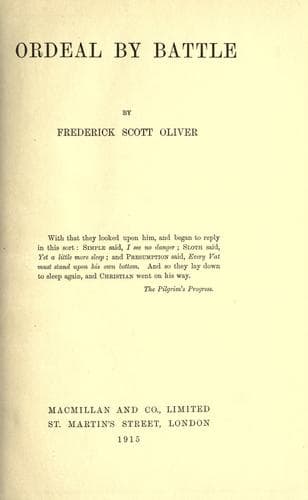
Draft -- Great Britain; Great Britain -- Defenses; World War, 1914-1918
No nation, unless it be utterly mad, will retain a form of government
which from some inherent defect is unable to protect itself against
external attack. Is democratic government capable of looking ahead,
making adequate and timely preparation, calling for and obtaining from
its people the sacrifices which are necessary in order to preserve
their own existence? Can it recover ground which has been lost, and
maintain a long, costly, and arduous struggle, until, by victory, it
has placed national security beyond the reach of danger?
Defeat in the present war would shake popular institutions to their
foundations in England as well as France; possibly also in regions
which are more remote than either of these. But something far short of
defeat--anything indeed in the nature of a drawn game or
stalemate--would assuredly bring the credit of democracy so low that it
would be driven to make some composition with its creditors.
Words, like other currencies, have a way of changing their values as
the world grows older. Until comparatively recent times 'democracy'
was a term of contempt, as 'demagogue' still is to-day.
The founders of American Union abhorred 'Democracy,'[1] and took every
precaution which occurred to them in order to ward it off. Their aim
was {170} 'Popular,' or 'Representative Government'--a thing which they
conceived to lie almost at the opposite pole. Their ideal was a state,
the citizens of which chose their leaders at stated intervals, and
trusted them. Democracy, as it appeared in their eyes, was a political
chaos where the people chose its servants, and expected from them only
servility. There was an ever-present danger, calling for stringent
safeguards, that the first, which they esteemed the best of all
constitutional arrangements, would degenerate into the second, which
they judged to be the worst.
Until times not so very remote it was only the enemies of
Representative Government, or its most cringing flatterers, who spoke
of it by the title of Democracy. Gradually, however, in the looseness
of popular discussions, the sharpness of the original distinction wore
off, so that the ideal system and its opposite--the good and the
evil--are now confounded together under one name. There is no use
fighting against current terminology; but it is well to bear in mind
that terminology has no power to alter facts, and that the difference
between the two principles still remains as wide as it was at the
beginning.
Public-domain text, read in full here on John Shaqi.
Reviews
Reviews
No reviews yet
Be the first to share your thoughts on this work.
Elsewhere in the archive
Join the Discussion
Join the discussion
Sign in to leave a comment or review.
Sign InorCreate an account