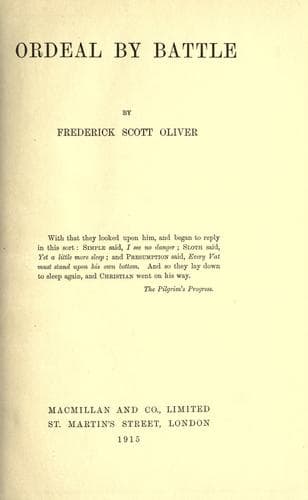
Draft -- Great Britain; Great Britain -- Defenses; World War, 1914-1918
When we pass from the conflict between systems of government, and come
to the other conflict of ideas as to right and wrong, we find ourselves
faced with an antagonism which is wholly incapable of accommodation.
In this war the stakes are something more than any of the material
interests involved. It is a conflict where one faith is pitted against
another. No casuistry will reconcile the ideal which inspires English
policy with the ideal which inspires German policy. There is no
sense--nothing indeed but danger--in arguing round the circle to prove
that the rulers of these two nations are victims of some frightful
misunderstanding, and that really at the bottom of their hearts they
believe the same things. This is entirely untrue: they believe quite
different things; things indeed which are as nearly as possible
opposites.
{174}
Our own belief is old, ingrained, and universal. It is accepted
equally by the people and their rulers. We have held it so long that
the articles of our creed have become somewhat blurred in
outline--overgrown, like a memorial tablet, by moss and lichen.
In the case of our enemy the tablet is new and the inscription sharp.
He who runs may read it in bold clear-cut lettering. But the belief of
the German people in the doctrine which has been carved upon the stone
is not yet universal, or anything like universal. It is not even
general. It is fully understood and accepted only in certain strata of
society; but it is responsible, without a doubt, for the making in cold
blood of the policy which has led to this war. When the hour struck
which the German rulers deemed favourable for conquest, war, according
to their creed, became the duty as well as the interest of the
Fatherland.
But so soon as war had been declared, the German people were allowed
and even encouraged to believe that the making of war from motives of
self-interest was a crime against humanity--the Sin against the Holy
Ghost. They were allowed and encouraged to believe that the Allies
were guilty of this crime and sin. And not only this, but war itself,
which had been hymned in so many professorial rhapsodies, as a noble
and splendid restorer of vigour and virtue, was now execrated with
wailing and gnashing of teeth, as the most hideous of all human
calamities.
Public-domain text, read in full here on John Shaqi.
Reviews
Reviews
No reviews yet
Be the first to share your thoughts on this work.
Elsewhere in the archive
Join the Discussion
Join the discussion
Sign in to leave a comment or review.
Sign InorCreate an account