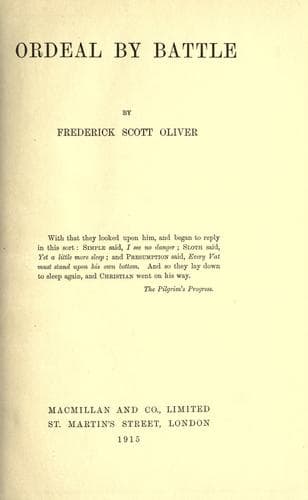
Draft -- Great Britain; Great Britain -- Defenses; World War, 1914-1918
And also, within this brief period, the highest offices had become
vacant, and many great figures had passed from the scene. Two
sovereigns had died full of honour. Two Prime Ministers had also died,
having first put off the burden of office, each at the zenith of his
popularity. Of the two famous men upon the Unionist side who remained
when Lord Salisbury tendered his resignation, the one since 1906 had
been wholly withdrawn from public life, {190} while the other, four
years later, had passed the leadership into younger hands.[10]
There is room for an almost infinite variety of estimate as to the
influence which is exercised by pre-eminent characters upon public
affairs and national ideals. The verdict of the day after is always
different from that of a year after. The verdict of the next
generation, while differing from both, is apt to be markedly different
from that of the generation which follows it. The admiration or
censure of the moment is followed by a reaction no less surely than the
reaction itself is followed by a counter-reaction. Gradually the
oscillations become shorter, as matters pass out of the hands of
journalists and politicians into those of the historian. Possibly
later judgments are more true. We have more knowledge, of a kind.
Seals are broken one by one, and we learn how this man really thought
and how the other acted, in both cases differently from what had been
supposed. We have new facts submitted to us, and possibly come nearer
the truth. But while we gain so much, we also lose in other
directions. We lose the sharp savour of the air. The keen glance and
alert curiosity of contemporary vigilance are lacking. Conditions and
circumstances are no longer clear, and as generation after generation
passes away they become more dim. The narratives of the great
historians and novelists are to a large extent either faded or false.
We do not trust the most vivid presentments written by the man of
genius in his study a century after the event, while we know well that
even the shrewdest of contemporaneous observers is certain to omit many
{191} of the essentials. If Macaulay is inadequate in one direction,
Pepys is equally inadequate in another. And if the chronicler at the
moment, and the historian in the future are not to be wholly believed,
the writer who comments after a decade or less upon things which are
fresh in his memory is liable to another form of error; for either he
is swept away by the full current of the reaction, or else his
judgments are embittered by a sense of the hopelessness of swimming
against it.
[Sidenote: DEATH OF QUEEN VICTORIA]
Public-domain text, read in full here on John Shaqi.
Reviews
Reviews
No reviews yet
Be the first to share your thoughts on this work.
Elsewhere in the archive
Join the Discussion
Join the discussion
Sign in to leave a comment or review.
Sign InorCreate an account