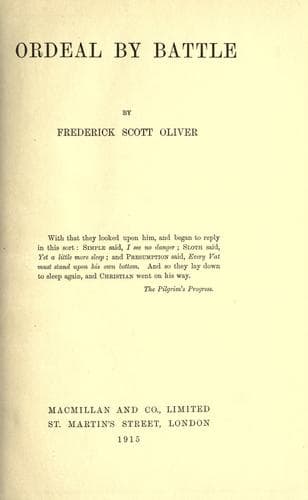
Draft -- Great Britain; Great Britain -- Defenses; World War, 1914-1918
Great characters are like tent-pegs. One of their uses is to prevent
the political camp from being blown to ribbons. Where they are too
short or too frail, we may look for such disorders as have repeated
themselves at intervals during the past few years. A blast of anger or
ill-temper has blown, or a gust of sentiment, or even a gentle zephyr
of sentimentality, and the whole scene has at once become a confusion
of flapping canvas, tangled cordage, and shouting, struggling humanity.
Such unstable conditions are fatal to equanimity; they disturb the
fortitude of the most stalwart follower, and cause doubt and distrust
on every hand.
Since the Liberal Government came into power in the autumn of 1905,
neither of the great parties had succeeded in earning the respect of
the other; and as the nature of man is not subject to violent
fluctuations, it may safely be concluded that this misfortune had been
due either to some defect or inadequacy of leadership, or else to
conditions of an altogether extraordinary character.
During these ten sessions the bulk of the statute book had greatly
increased, and much of this increase was no doubt healthy tissue. This
period, notwithstanding, {195} will ever dwell in the memory as a
squalid episode. Especially is this the case when we contrast the high
hopes and promises, not of one party alone, with the results which were
actually achieved.
[Sidenote: DEMOCRACY AND LEADERSHIP]
Democracy, if the best, is also the most delicate form of human
government. None suffers so swiftly or so sorely from any shortage in
the crop of character. None is so dependent upon men, and so little
capable of being supported by the machine alone. When the leading of
parties is in the hands of those who lack vision and firmness, the
first effect which manifests itself is that parties begin to slip their
principles. Some secondary object calls for and obtains the sacrifice
of an ideal. So the Unionists in 1909 threw over the order and
tradition of the state, the very ark of their political covenant, when
they procured the rejection of the Budget by the House of Lords. So
the Liberal Government in 1910, having solemnly undertaken to reform
the constitution--a work not unworthy of the most earnest
endeavour--went back upon their word, and abandoned their original
purpose. For one thing they grew afraid of the clamour of their
partisans. For another they were tempted by the opportunity of
advantages which--as they fondly imagined--could be easily and safely
secured during the interval while all legislative powers were
temporarily vested in the Commons. Nor were these the only instances
where traditional policy had been diverted, and where ideals had been
bargained away, in the hope that thereby objects of a more material
sort might be had at once in exchange.
Public-domain text, read in full here on John Shaqi.
Reviews
Reviews
No reviews yet
Be the first to share your thoughts on this work.
Elsewhere in the archive
Join the Discussion
Join the discussion
Sign in to leave a comment or review.
Sign InorCreate an account