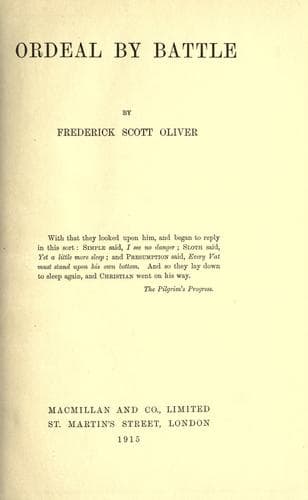
Draft -- Great Britain; Great Britain -- Defenses; World War, 1914-1918
Of course there have been, and will ever be, exceptions. Alexander
Hamilton was a lawyer, though he was a soldier in the first instance.
Abraham Lincoln was a lawyer. But we should have to go back to the
'glorious revolution' of 1688 before we could find a parallel to either
of these two in our own history. Until the last two decades England
has never looked favourably on lawyer leaders. This was regarded by
some as a national peculiarity; by others as a safeguard of our
institutions. But by the beginning of the twentieth century it was
clear that lawyers had succeeded in establishing their predominance in
the higher walks of English politics, as thoroughly as they had already
done wherever parliamentary government exists throughout the world.
[Sidenote: MR. ASQUITH'S ORATORY]
During this epoch, when everything was sacrificed to perspicuity and
the avoidance of boredom, Mr. Asquith's utterances led the fashion.
His ministry was composed to a large extent of politicians bred in the
same profession and proficient in the same arts as himself; but he
towered above them all, the supreme type of the lawyer-statesman.
His method was supremely skilful. In its own way it had the charm of
perfect artistry, even though {204} the product of the art was hardly
more permanent than that of the _cordon bleu_ who confections ices in
fancy patterns. And not only was the method well suited to the taste
of popular audiences, but equally so to the modern House of Commons.
That body, also, was now much better educated in matters which can be
learned out of newspapers and books; far more capable of expressing its
meanings in well-chosen phrases arranged in a logical sequence; far
more critical of words--if somewhat less observant of things--than it
was during the greater part of the reign of Queen Victoria.
To a large extent the House of Commons consisted of persons with whom
public utterance was a trade. There were lawyers in vast numbers,
journalists, political organisers, and professional lecturers on a
large variety of subjects. And even among the labour party, where we
might have expected to find a corrective, the same tendency was at
work, perhaps as strongly as in any other quarter. For although few
types of mankind have a shrewder judgment between reality and dialectic
than a thoroughly competent 'workman,' labour leaders were not chosen
because they were first-class workmen, but because they happened to be
effective speakers on the platform or at the committee table.
Public-domain text, read in full here on John Shaqi.
Reviews
Reviews
No reviews yet
Be the first to share your thoughts on this work.
Elsewhere in the archive
Join the Discussion
Join the discussion
Sign in to leave a comment or review.
Sign InorCreate an account