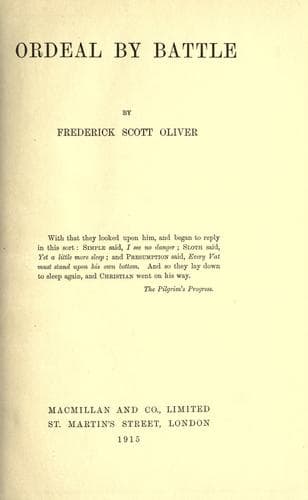
Draft -- Great Britain; Great Britain -- Defenses; World War, 1914-1918
The position after Queen Victoria's death also differed from all
previous times in another way. After more than three centuries of
turmoil and expansion, the British race had entered into possession of
an estate so vast, so rich in all natural resources, that a sane mind
could not hope for, or even dream of, any further aggrandisement.
Whatever may be the diseases from which the British race suffered
during the short epoch between January 1901 and July 1914, megalomania
was certainly not one of them.
The period of acquisition being now acknowledged at an end, popular
imagination became much occupied with other things. It assumed, too
lightly and readily perhaps, that nothing was likely to interfere with
our continuing to hold what we had got. If there was not precisely a
law of nature, which precluded the possessions of the British Empire
from ever being {209} taken away, at any rate there was the law of
nations. The public opinion of the world would surely revolt against
so heinous a form of sacrilege. Having assumed so much, placidly and
contentedly, and without even a tremor either as to the good-will or
the potency of the famous Concert of Europe, the larger part of public
opinion tended to become more and more engrossed in other problems. It
began to concern itself earnestly with _the improvement of the
condition of the people_, and with _the reform and consolidation of
institutions_. Incidentally, and as a part of each of these
endeavours, the development of an estate which had come, mainly by
inheritance, into the trusteeship of the British people, began
seriously to occupy their thoughts.
[Sidenote: SOCIAL AND CONSTITUTIONAL REFORM]
These were problems of great worth and dignity, but nevertheless there
was one condition of their successful solution, which ought to have
been kept in mind, but which possibly was somewhat overlooked. If we
allowed ourselves to be so much absorbed by these two problems that we
gave insufficient heed to our defences, it was as certain as any human
forecast could be, that the solution of a great deal, which was
perplexing us in the management of our internal affairs, would be
summarily taken out of the hands of Britain and her Dominions and
solved according to the ideas of strangers.
If we were to bring our policy of social and constitutional improvement
and the development of our estate to a successful issue, we must be
safe from interruption from outside. We must secure ourselves against
foreign aggression; for we needed time. Our various problems could not
be solved in a day or even in a generation. The most urgent {210} of
all matters was _security_, for it was the prime condition of all the
rest.
We desired, not merely to hold what we had got, but to enjoy it, and
make it fructify and prosper, in our own way, and under our own
institutions. For this we needed peace within our own sphere; and
therefore it was necessary that we should be strong enough to enforce
peace.
Public-domain text, read in full here on John Shaqi.
Reviews
Reviews
No reviews yet
Be the first to share your thoughts on this work.
Elsewhere in the archive
Join the Discussion
Join the discussion
Sign in to leave a comment or review.
Sign InorCreate an account