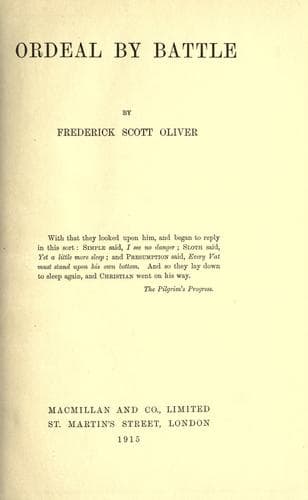
Draft -- Great Britain; Great Britain -- Defenses; World War, 1914-1918
Popular judgment may be trusted as a rule, and in the long run, to
decide a clear issue between truth and falsehood, and to decide it in
favour of the former. But it becomes perplexed, when it is called upon
to discriminate between the assurances of two rival sets of showmen,
whose eagerness to outbid each other in the public favour leaves
truthfulness out of account. In the absence of gold, one brazen
counterfeit rings very much like another. People may be suspicious of
both coins; but on the whole their fancy is more readily caught by the
optimist effigy than the pessimist. They may not place entire trust in
the 'ever-cheerful man of sin,' with his flattery, his abounding
sympathy, his flowery promises, and his undefeated hopefulness; but
they prefer him at any rate to 'the melancholy Jaques,' booming
maledictions with a mournful {215} constancy, like some bittern in the
desolation of the marshes.
So far as principles were concerned most of the trouble was
unnecessary. Among the would-be reformers--among those who sincerely
desired to bring about efficiency within their own spheres--there was
surprisingly little that can truly be called antagonism. But
competition of an important kind--competition for public attention and
priority of treatment--had produced many of the unfortunate results of
antagonism. It was inevitable that this lamentable state of things
must continue, until it had been realised that one small body of men,
elected upon a variety of cross issues, could not safely be left in
charge of the defence of the Empire, the domestic welfare of the United
Kingdom, and the local government of its several units.
[Sidenote: ARTIFICIAL ANTAGONISMS]
It was not merely that the various aims were not opposed to one
another; they were actually helpful to one another. Often, indeed,
they were essential to the permanent success of one another. The man
who desired to improve the conditions of the poor was not, therefore,
the natural enemy of him who wanted to place the national defences on a
secure footing. And neither of these was the natural enemy of others
who wished to bring about a settlement of the Irish question, or of the
Constitutional question, or of the Imperial question. But owing partly
to the inadequacy of the machinery for giving a free course to these
various aspirations--partly to the fact that the machinery itself was
antiquated, in bad repair, and had become clogged with a variety of
obstructions--there was an unfortunate tendency on the part of every
one who had any particular object very much {216} at heart, to regard
every one else who was equally concerned about any other object as an
impediment in his path.
Public-domain text, read in full here on John Shaqi.
Reviews
Reviews
No reviews yet
Be the first to share your thoughts on this work.
Elsewhere in the archive
Join the Discussion
Join the discussion
Sign in to leave a comment or review.
Sign InorCreate an account