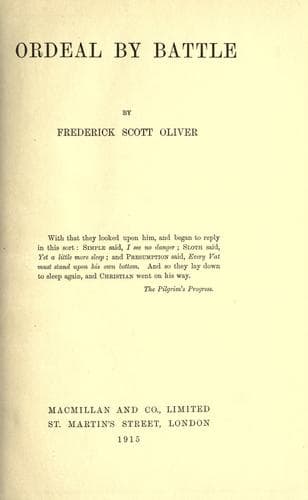
Draft -- Great Britain; Great Britain -- Defenses; World War, 1914-1918
During the nineteenth century, except at the very beginning, and again
at the very end of it, very few people ever thought of going into
Parliament, or even into politics, in order that they might thrive
thereby, or find a field for improving their private fortunes. This
cannot be said with truth of the epoch which has just ended. There has
been a change both in tone and outlook during the last thirty years.
Things have been done and approved by the House of Commons, elected in
December 1910, which it is quite inconceivable that the House of
Commons, returned in 1880, would ever have entertained. The
Gladstonian era had its faults, but among them laxity in matters of
finance did not figure. Indeed private members, as well as statesmen,
not infrequently {218} crossed the border-line which separates purism
from pedantry; occasionally they carried strictness to the verge of
absurdity; but this was a fault in the right direction--a great
safeguard to the public interest, a peculiarly valuable tendency from
the standpoint of democracy.
A twelvemonth ago a number of very foolish persons were anxious to
persuade us that the predominant issue was the Army _versus_ the
People. But even the crispness of the phrase was powerless to convince
public opinion of so staggering an untruth. The predominant issue at
that particular moment was only what it had been for a good many years
before--the People _versus_ the Party System.
[Sidenote: NEED OF RICH MEN]
What is apt to be ignored is, that with the increase of wealth on the
one hand, and the extension of the franchise on the other, the Party
System has gradually become a vested interest upon an enormous
scale,--like the liquor trade of which we hear so much, or the _haute
finance_ of which perhaps we hear too little. Rich men are required in
politics, for the reason that it is necessary to feed and clothe the
steadily increasing swarms of mechanics who drive, and keep in repair,
and add to, that elaborate machinery by means of which the Sovereign
People is cajoled into the belief that its Will prevails. From the
point of view of the orthodox political economist these workers are as
unproductive as actors, bookmakers, or golf professionals; but they
have to be paid, otherwise they would starve, and the machines would
stop. So long as there are plenty of rich men who desire to become
even richer, or to decorate their names with titles, or to move in
shining circles, this is not at all likely to occur, unless the Party
System {219} suddenly collapsed, in which case there would be acute
distress.
Public-domain text, read in full here on John Shaqi.
Reviews
Reviews
No reviews yet
Be the first to share your thoughts on this work.
Elsewhere in the archive
Join the Discussion
Join the discussion
Sign in to leave a comment or review.
Sign InorCreate an account