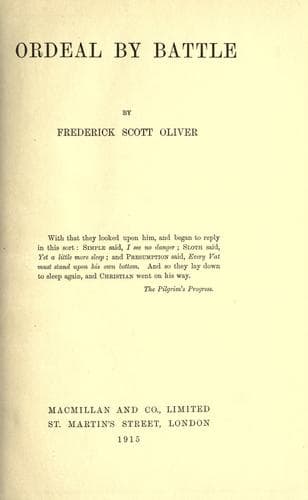
Draft -- Great Britain; Great Britain -- Defenses; World War, 1914-1918
The drawing together of the world by steam and electricity has brought
conspicuous benefits to the British Empire. The five self-governing
nations of which it is composed come closer together year by year.
Statesmen and politicians broaden the horizons of their minds by swift
and easy travel. But there are drawbacks as well as the reverse under
these new conditions. To some extent the personnel of democracy has
tended to become interchangeable, like the parts of a bicycle; and
public characters are able to transfer their activities from one state
to another, and even from one hemisphere to another, without a great
deal of difficulty. This has certain advantages, but possibly more
from the point of view of the individual than from that of the
Commonwealth. After failure in one sphere there is still hope in
another. Mr. Micawber, or even Jeremy Diddler, may go the round, using
up public confidence at one resting-place after another. For the Party
System is a ready employer, and providing a man has a glib tongue, a
forehead of brass, or an open purse, a position will be found for him
without too much enquiry made into his previous references.
[Sidenote: LAWYERISM AND LEADERSHIP]
In a world filled with confusion and illusion the Party System has
fought at great advantage. Indeed it is generally believed to be so
firmly entrenched that nothing can ever dislodge it. There are
dangers, however, in arguing too confidently from use and wont.
Conspicuous failure or disaster might bring {221} ruin on this revered
institution, as it has often done in history upon others no less
venerable. The Party System has its weak side. Its wares are mainly
make-believes, and if a hurricane happens to burst suddenly, the caucus
may be left in no better plight than Alnaschar with his overturned
basket. The Party System is not invulnerable against a great man or a
great idea. But of recent years it has been left at peace to go its
own way, for the reason that no such man or idea has emerged, around
which the English people have felt that they could cluster confidently.
There has been no core on which human crystals could precipitate and
attach themselves, following the bent of their nature towards a firm
and clear belief--or towards the prowess of a man--or towards a Man
possessed by a Belief. The typical party leader during this epoch has
neither been a man in the heroic sense, nor has he had any belief that
could be called firm or clear. For the most part he has been merely a
Whig or Tory tradesman, dealing in opportunism; and for the
predominance of the Party System this set of conditions was almost
ideal. It was inconceivable that a policy of wait-and-see could ever
resolve a situation of this sort. To fall back on lawyerism was
perhaps inevitable in the circumstances; but to think that it was
possible to substitute lawyerism for leadership was absurd.
Public-domain text, read in full here on John Shaqi.
Reviews
Reviews
No reviews yet
Be the first to share your thoughts on this work.
Elsewhere in the archive
Join the Discussion
Join the discussion
Sign in to leave a comment or review.
Sign InorCreate an account