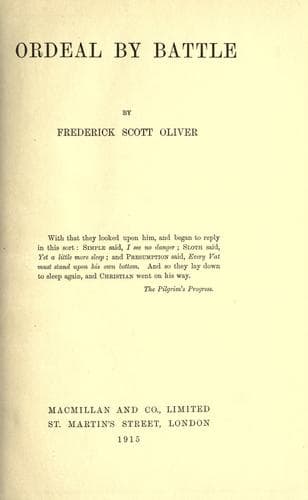
Draft -- Great Britain; Great Britain -- Defenses; World War, 1914-1918
A nation which desired to extend its possessions, to round off its
territories, to obtain access to the sea, would probably regard
conquest, or at all events absorption, as its highest immediate
interest. This would be the constant aim of its policy, and if its
armaments did not conform to this policy, the aim would not be
realised. Examples both of failure and success are to be found in the
history of Russia from the time of Peter the Great, and in that of
Prussia from the days of the Great Elector.
A nation--like England or Holland in the sixteenth, seventeenth, and
eighteenth centuries--which {231} was seeking to secure against its
commercial rivals, if necessary by force of arms, new markets among
civilised but unmilitary races, would require a policy and armaments to
correspond.
[Sidenote: BRITISH CONTENTMENT]
The British Empire in the stage of development which it had reached at
the end of the Victorian era did not aim at acquisition of fresh
territories or new markets, save such as might be won peacefully by the
skill and enterprise of its merchants. It sought only to hold what it
already possessed, to develop its internal resources, and to retain
equal rights with its commercial rivals in neutral spheres. But in
order that those unaggressive objects might be realised, there was need
of a policy, different indeed from that of Elizabeth, of Cromwell, or
of Chatham, but none the less clear and definite with regard to its own
ends. And to support this policy there was need of armaments, suitable
in scale and character.
It was frequently pointed out between the years 1901 and 1914 (and it
lay at the very root of the matter), that while we were perfectly
satisfied with things as they stood, and should have been more than
content--regarding the subject from the standpoint of our own
interests--to have left the map of the world for ever, as it then was
drawn, another nation was by no means so well pleased with existing
arrangements. To this envious rival it appeared that we had taken more
than our fair share--as people are apt to do who come early. We had
wider territories than we could yet fill with our own people; while our
neighbour foresaw an early date at which his race would be overflowing
its boundaries. We had limitless resources in the Dominions and
Dependencies {232} overseas, which when developed would provide a
united empire with markets of inestimable value. In these respects
Germany was in a less favourable position. Indeed, with the exceptions
of Russia and the United States, no other great Power was so
fortunately placed as ourselves; and even these two nations, although
they had an advantage over the British Empire by reason of their huge
compact and coterminous territories, still did not equal it in the
vastness and variety of their undeveloped resources.
Public-domain text, read in full here on John Shaqi.
Reviews
Reviews
No reviews yet
Be the first to share your thoughts on this work.
Elsewhere in the archive
Join the Discussion
Join the discussion
Sign in to leave a comment or review.
Sign InorCreate an account