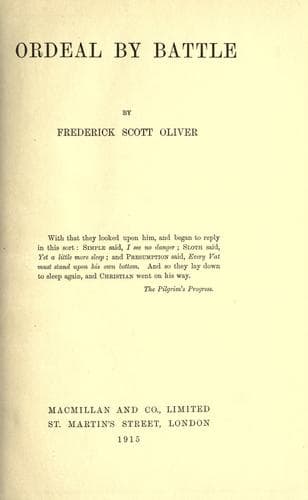
Draft -- Great Britain; Great Britain -- Defenses; World War, 1914-1918
This opinion was not by any means unanimously or clearly held; but
during the summer of 1911 and subsequently, it was undoubtedly the
hypothesis upon which those members of our Government relied, who were
chiefly responsible for the conduct of foreign affairs. Unfortunately
Parliament and the country had never accepted either the policy or its
consequences; they had never been asked to accept either the one or the
other; nor had they been educated with a view to their acceptance.
At that time the error was exceedingly prevalent, that it is a more
comfortable business fighting in your own country than in somebody
else's. From this it followed that it would be folly to engage in what
were termed disapprovingly 'foreign adventures,' and that we should be
wise to await attack behind our own shores. Recent events have wrought
such a complete and rapid conversion from this heresy, that it is no
longer worth while wasting words in exposing it. It is necessary,
however, to recall how influential this view of the matter was, not
only up to the declaration of war, but even for some time afterwards.
As to the precise form of co-operation between the members of the
Triple Entente in case of war, there could be no great mystery. It was
obvious to any one who paid attention to what happened during the
summer and autumn of 1911, that in the event of Germany attacking
France over the Agadir dispute, we had let it be understood and
expected, that we should send our Expeditionary Force across the
Channel to co-operate with the French army on the north-eastern
frontier.
[1] It can hardly be overlooked, however, that this principle, rightly
or wrongly interpreted, had something to do with the Crimean War
(1854-56) and with the British attitude at the Congress of Berlin
(1878).
[2] Viscount Milner in the _United Service Magazine_, January 1912.
{252}
CHAPTER V
THE MILITARY SITUATION
(August 1911)
The full gravity of the Agadir incident, though apparent to other
nations, was never realised by the people of this country. The crisis
arose suddenly in July 1911. Six weeks later it had subsided; but it
was not until well on in the autumn that its meanings were grasped,
even by that comparatively small section of the public who interest
themselves in problems of defence and foreign affairs. From October
onwards, however, an increasing number began to awake to the fact, that
war had only been avoided by inches, and to consider seriously--many of
them for the first time in their lives--what would have happened if
England had become involved in a European conflict.
[Sidenote: THE EXPEDITIONARY FORCE]
Public-domain text, read in full here on John Shaqi.
Reviews
Reviews
No reviews yet
Be the first to share your thoughts on this work.
Elsewhere in the archive
Join the Discussion
Join the discussion
Sign in to leave a comment or review.
Sign InorCreate an account