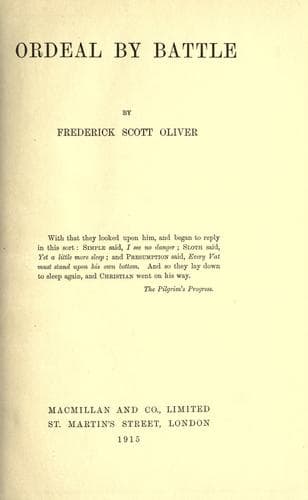
Draft -- Great Britain; Great Britain -- Defenses; World War, 1914-1918
An undertaking of this tenor went beyond those assurances of
non-aggressive intent which Lord Haldane, on behalf of his own
Government, was fully prepared to give. We would not be a party to any
unprovoked attack on Germany--was not that sufficient? It was plainly
insufficient. It was made clear that Germany desired a free hand to
establish herself in a position of supremacy astride of Europe. So
Lord Haldane returned profitless from his wayfaring, and the British
Government was at its wits' end how to placate the implacable.
The way they chose was well-doing, in which they wearied themselves
perhaps overmuch, especially during the Balkan negotiations. For
Germany did not want war at that time, for the reasons which have been
given already. And so, rather surlily, and with the air of one who was
humouring a crank--a pusillanimous people whose fixed idea was
pacifism--she consented that we should put ourselves to vast trouble to
keep the peace for her benefit. If {289} war had to come in the end,
it had much better have come then--so far as we were concerned--seeing
that the combined balance of naval and military power was less
unfavourable to the Triple Entente at the beginning of 1913 than it was
some fifteen months later.... This was all the notice we took of the
fifth warning. We earned no gratitude by our activities, nor added in
any way thereby to our own safety.
[Sidenote: THE HALDANE MISSION]
The Haldane mission is a puzzle from first to last. The Kaiser had
asked that he should be sent.... For what purpose? ... Apparently in
order to discuss the foreign policy of England and Germany. But surely
the Kaiser should have been told that we kept an Ambassador at Berlin
for this very purpose; an able man, habituated to stand in the strong
sunlight of the imperial presence without losing his head; but, above
all, qualified to converse on such matters (seeing that they lay within
his own province) far better than the most profound jurist in
Christendom. Or if our Ambassador at Berlin could not say what was
required, the German Ambassador in London might easily have paid a
visit to Downing Street; or the Foreign Ministers of the two countries
might have arranged a meeting; or even the British Premier and the
German Chancellor might have contrived to come together. Any of these
ways would have been more natural, more proper, more likely (one would
think) to lead to business, than the way which was followed.
One guesses that the desire of the Kaiser that Lord Haldane should be
sent, was met half-way by the desire of Lord Haldane to go forth; that
there was some temperamental affinity between these {290} two
pre-eminent characters--some attraction of opposites, like that of the
python and the rabbit.
Public-domain text, read in full here on John Shaqi.
Reviews
Reviews
No reviews yet
Be the first to share your thoughts on this work.
Elsewhere in the archive
Join the Discussion
Join the discussion
Sign in to leave a comment or review.
Sign InorCreate an account