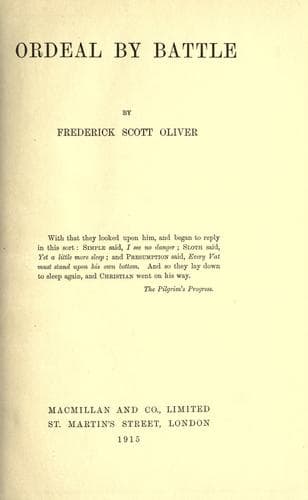
Draft -- Great Britain; Great Britain -- Defenses; World War, 1914-1918
It is therefore absurd to suppose that ministers could have failed to
realise the extent of the danger, or of our unpreparedness to meet it,
unless they had purposely buried their heads in the sand. They knew
that they had not a big enough army, and that this fact might ruin
their whole policy. Why did they never say so? Why, when Lord Roberts
said so, did they treat him with contumely, and make every effort to
discredit him? Why was nothing done by them during their whole period
of office to increase the Army and thereby diminish the {298} numerical
superiority of their adversaries. On the contrary, they actually
reduced the Army, assuring the country that they had no use for so many
trained soldiers. Moreover, the timidity or secretiveness of the
Government prevented England from having, what is worth several army
corps, and what proved the salvation of France--a National Policy,
fully agreed and appealing to the hearts and consciences of the whole
people.
The answers to these questions must be sought in another sphere. The
political situation was one of great perplexity at home as well as
abroad, and its inherent difficulties were immeasurably increased by
the character and temperament of Mr. Asquith, by the nature no less of
his talents than of his defects. The policy of wait-and-see is not
necessarily despicable. There are periods in which it has been the
surest wisdom and the truest courage; but this was not one of those
periods, nor was there safety in dealing either with Ireland or with
Germany upon this principle. When a country is fully prepared it can
afford to wait and see if there will be a war; but not otherwise.
Sir Edward Grey is a statesman whose integrity and disinterestedness
have never been impugned by friend or foe; but from the very beginning
of his tenure of office he has appeared to lack that supreme quality of
belief in himself which stamps the greatest foreign ministers. He has
seemed at times to hesitate, as if in doubt whether the dangers which
he foresaw with his mind's eye were realities, or only nightmares
produced by his own over-anxiety. We have a feeling also that in the
conduct of his office he had {299} played too lonely a part, and that
such advice and sympathy as he had received were for the most part of
the wrong sort. What he needed in the way of counsel and companionship
was simplicity and resolution. What he had to rely on was the very
reverse of this.
Lord Haldane, as we have learned recently, shared largely in the work
of the Foreign Office; a man of prodigious industry, but
over-ingenious, and of a self-complacency which too readily beguiled
him into the belief that there was no opponent who could not be
satisfied, no obstacle which could not be made to vanish--by argument.
[Sidenote: SIR EDWARD GREY'S DIFFICULTIES]
Public-domain text, read in full here on John Shaqi.
Reviews
Reviews
No reviews yet
Be the first to share your thoughts on this work.
Elsewhere in the archive
Join the Discussion
Join the discussion
Sign in to leave a comment or review.
Sign InorCreate an account