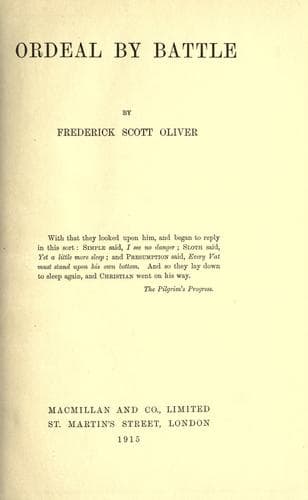
Draft -- Great Britain; Great Britain -- Defenses; World War, 1914-1918
"The one virtue of voluntary enlistment is that it should be
voluntary--a free choice between a soldier's life and a civilian's
life. To use moral pressure, with the outcries of public indignation,
in order to drive civilians from their work into the army--what is this
but a most undignified compulsion? And it is also a compulsion that
presses unequally upon the people, for its methods are without system.
Many families send their all into the fighting line; many decline to be
patriotic. A woman said to me yesterday: 'My husband has gone, and I
am left with his business. Why should he go? Other women in my
neighbourhood have their husbands still, and it's rubbish to say that
the country is in danger when the Government allows and encourages this
injustice in recruiting. If the country is in danger all the men
should fight--if their trade work is unnecessary to the armies."
"This point of view is right; the wrong one is advocated by you and by
other Radicals who dislike the justice of democratic equality.--Yours
truly, WALTER SHAW SPARROW."
[6] There have been bitter complaints of this artful way of getting
recruits, as a boy 'sniggles' trout. The following letter to the Times
(April 21, 1915) voices a very widely spread sense of injustice:
"SIR--Will you give me the opportunity to ask a question, which I think
you will agree is important? When the Circular to Householders was
issued, many heads of families gave in their names on the assumption
that they would be called up on the last resort, and under
circumstances in which no patriotic man could refuse his help. Married
men with large families are now being called up apparently without the
slightest regard to their home circumstances. Many of the best of them
are surprised and uneasy at leaving their families, but feel bound in
honour to keep their word, some even thinking they have no choice. The
separation allowances for these families will be an immense burden on
the State, and, if the breadwinner falls, a permanent burden. Is the
need for men still so serious and urgent as to justify this? If it is,
then I for one, who have up to now hoped that the war might be put
through without compulsion, feel that the time has come to 'fetch' the
unmarried shirkers, and I believe there is a wide-spread and growing
feeling to that effect.--I am, Sir, etc., CHARLES G. E. WELBY."
[7] An example of the apparent inability of the Government to do
anything thoroughly or courageously is found in a circular letter to
shopkeepers and wholesale firms, which was lately sent out by the Home
Secretary and the President of the Board of Trade. The object of this
enquiry--undertaken at leisure, nine months after the outbreak of
war--is to obtain information as to the number of men of military age,
who are still employed in these particular trades, and as to the
willingness of their employers to spare them if required, and to
reinstate them at the end of the war, etc., etc.
Public-domain text, read in full here on John Shaqi.
Reviews
Reviews
No reviews yet
Be the first to share your thoughts on this work.
Elsewhere in the archive
Join the Discussion
Join the discussion
Sign in to leave a comment or review.
Sign InorCreate an account