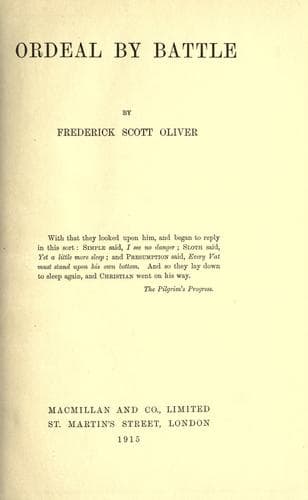
Draft -- Great Britain; Great Britain -- Defenses; World War, 1914-1918
If 'National Service,' or 'Conscription,' has actually become necessary
already, or may conceivably become so before long, it seems worth while
to glance at some of the considerations which have been urged in favour
of this system in the past, and also to examine some of the causes and
conditions which have hitherto led public opinion in the United
Kingdom, as well as in several of the Dominions, to regard the
principle of compulsion with hostility and distrust. The true nature
of what we call the 'Voluntary System,' and the reasons which have
induced a large section of our fellow-countrymen to regard it as one of
our most sacred institutions, are worth looking into, now that
circumstances may force us to abandon it in the near future.
Beyond the question, whether the system of recruiting, which has been
employed during the present war, can correctly be described as
'voluntary,' there is the further question, whether the system, which
is in use at ordinary times, and which produces some 35,000 men per
annum, can be so described. Lord Roberts always maintained that it
could not, and that its true title was 'the Conscription of Hunger.'
{383}
[Sidenote: NORMAL RECRUITING METHODS]
Any one who has watched the recruiting-sergeant at work, on a raw cold
day of winter or early spring, will be inclined to agree with Lord
Roberts. A fine, good-humoured, well-fed, well-set-up fellow, in a
handsome uniform, with rows of medals which light up the mean and dingy
street, lays himself alongside some half-starved poor devil, down in
his luck, with not a rag to his back that the north wind doesn't blow
through. The appetites and vanities of the latter are all of them
morbidly alert--hunger, thirst, the desire for warmth, and to cut a
smart figure in the world. The astute sergeant, though no professor of
psychology, understands the case thoroughly, as he marks down his man.
He greets him heartily with a 'good day' that sends a glow through him,
even before the drink at the Goat and Compasses, or Green Dragon has
been tossed off, and the King's shilling accepted.
Not that there is any need for pity or regret. These young men with
empty bellies, and no very obvious way of filling them, except by
violence--these lads with gloom at their hearts, in many cases with a
burden of shame weighing on them at having come into such a forlorn
pass--in nine cases out of ten enlistment saves them; perhaps in more
even than that.
Public-domain text, read in full here on John Shaqi.
Reviews
Reviews
No reviews yet
Be the first to share your thoughts on this work.
Elsewhere in the archive
Join the Discussion
Join the discussion
Sign in to leave a comment or review.
Sign InorCreate an account