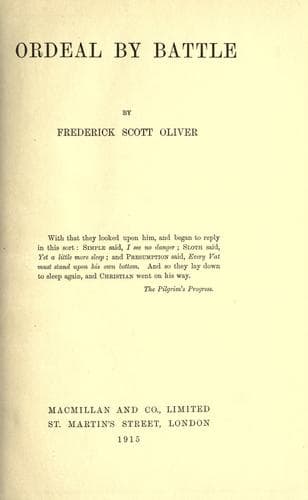
Draft -- Great Britain; Great Britain -- Defenses; World War, 1914-1918
The British nation, if not actually the richest, is at any rate one of
the richest in the world. It has elected to depend for its safety upon
an army which cannot with justice be called either 'voluntary' or
'mercenary,' but which it is fairly near the truth to describe as
'professional.' The theory of our arrangement is that we must somehow,
and at the cheapest rate, contrive to tempt enough men to become
professional soldiers to ensure national safety. Accordingly we offer
such inducements to take up {391} the career of arms--instead of the
trades of farm labourer, miner, carpenter, dock hand, shopkeeper,
lawyer, physician, or stockbroker--as custom and the circumstances of
the moment appear to require.
In an emergency we offer high pay and generous separation allowances to
the private soldier. In normal times we give him less than the market
rate of wages.
[Sidenote: PAY OF THE BRITISH ARMY]
The pay of junior or subaltern officers is so meagre that it cannot, by
any possibility, cover the expenses which Government insists upon their
incurring. Captains, majors, and lieutenant-colonels are paid much
less than the wages of foremen or sub-managers in any important
industrial undertaking. Even for those who attain the most brilliant
success in their careers, there are no prizes which will stand
comparison for a moment with a very moderate degree of prosperity in
the world of trade or finance. They cannot even be compared with the
prizes open to the bar or the medical profession.
Hitherto we have obtained our officers largely owing to a firmly rooted
tradition among the country gentlemen and the military
families--neither as a rule rich men, or even very easy in their
circumstances as things go nowadays--many of them very poor--a
tradition so strong that it is not cant, but plain truth, to call it
sense of duty. There are other motives, of course, which may lead a
boy to choose this profession--love of adventure, comparative freedom
from indoor life, pleasant comradeship, and in the case of the middle
classes, recently risen to affluence, social aspirations. But even in
the last there is far more good than harm; though in anti-militarist
circles it is the unworthy aim which is usually dwelt upon with {392} a
sneering emphasis. For very often, when a man has risen from humble
circumstances to a fortune, he rejoices that his sons should serve the
state, since it is in his power to make provision. The example of his
neighbours, whose ancestors have been living on their acres since the
days of the Plantagenets or the Tudors, is a noble example; and he is
wise to follow it.
Public-domain text, read in full here on John Shaqi.
Reviews
Reviews
No reviews yet
Be the first to share your thoughts on this work.
Elsewhere in the archive
Join the Discussion
Join the discussion
Sign in to leave a comment or review.
Sign InorCreate an account