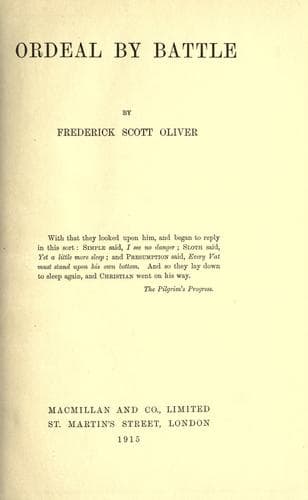
Draft -- Great Britain; Great Britain -- Defenses; World War, 1914-1918
Disregarding the entreaties of his friends, to beware of asking of the
people 'what the people would never stand,' disregarding the clamours
of his enemies about personal freedom, he insisted upon conscription,
believing that by these means alone the Union could be saved. And what
was the result? A section of the press foamed with indignation. Mobs
yelled, demonstrated, and in their illogical fury, lynched negroes,
seeing in these unfortunates the cause of all their troubles. But the
mobs were not the American people. They were only a noisy and
contemptible minority of the American people, whose importance as well
as courage had been vastly over-rated. The quiet people were in deadly
earnest, and they supported their President.[3]
[Sidenote: LINCOLN AND CONSCRIPTION]
But the task which Lincoln set himself was one of the hardest that a
democratic statesman ever undertook. The demand which he determined to
make, and did make, may well have tried his heart as he sat alone in
the night watches. For compulsion was a violation of the habits and
prejudices of the old American stock, while it was even more
distasteful to new immigrants. It was contrary to the traditions and
theories of the Republic, and, as many thought, to its fundamental
principles. It was open to scornful attack on grounds of sentiment.
Against a foe who were so weak, both in numbers and wealth, how
humiliating to be driven to such desperate measures! But most of
all--outweighing all other considerations--this war of North and South
was not only war, but civil war. Families and lifelong friendships
were divided. What compulsion meant, therefore, in this case was, that
brothers were to be forced to {419} kill brothers, husbands were to be
sent out to slay the kinsmen of their wives, or--as they marched with
Sherman through Georgia--to set a light with their own hands to the old
homesteads where they had been born. Between the warring States there
were no differences of blood, tradition, or religion; or of ideas of
right and wrong; no hatred against a foreign race; only an acute
opposition of political ideals. Compulsion, therefore, was a great
thing to ask of the American people. But the American people are a
great people, and they understood. And Lincoln was a great man,--one
of the greatest, noblest, and most human in the whole of history,--and
he did not hesitate to ask, to insist, and to use force. What the end
was does not need to be stated here; except merely this, that a
lingering and bloody war was thereby greatly shortened, and that the
Union was saved.
Public-domain text, read in full here on John Shaqi.
Reviews
Reviews
No reviews yet
Be the first to share your thoughts on this work.
Elsewhere in the archive
Join the Discussion
Join the discussion
Sign in to leave a comment or review.
Sign InorCreate an account