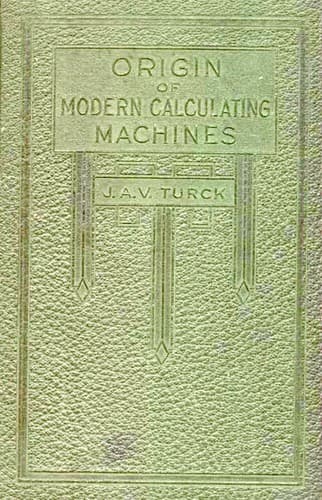
Origin of modern calculating machinesTurck, J. A. V.
History
Origin of modern calculating machines
Turck, J. A. V.
Calculators
It is within reason that a locking action of that character would
even defeat the speed of key-action that was possible on the old
“Comptometer,” since an operator could overlap the key strokes in
that machine to a certain extent; whereas the forced simultaneity of
the cash register, if applied to the “Comptometer,” would prevent any
overlapping or the depression of a second key until the first depressed
key returned.
The only simultaneity of key-action that could provide a means of
speeding up the old “Comptometer,” or any machine of its type, was a
means that would leave key-depression free as to matter of time; one
that would be perfectly flexible in group manipulation, offering a
complete fluidity of motion such as not to hinder the fingering of the
operator.
The purpose of the mechanical means employed to give simultaneity in
the cash register was to lock all the keys depressed together and lock
all others against depression until the former returned. The purpose
of mechanical means employed in the Felt patent was to give perfect
freedom of key-action, whereas formerly the key manipulation of the
old “Comptometer” was restricted in the freedom of key-action, to the
extent of being limited to seriatum action.
The above discussion has been somewhat elaborately detailed to offset
statements that simultaneity was old in the key-driven Art. There is
no question as to the cash register type of inflexible simultaneity of
action being old before Felt patented his flexible type of simultaneity
of key-action for a key-driven calculating machine; but any statement
intended to convey the idea that Felt’s contribution of the flexible
simultaneity of key-action to the Art was not new, must come from
ignorance of the facts or malice aforethought.
[Sidenote: _Duplex Comptometer_]
This flexible keyboard “Comptometer” was given the trade name of
“Duplex Comptometer;” the term “Duplex” meaning that two keys could be
depressed, as distinguished from the seriatum one at a time key-action
formerly required. The term, however, fell short of setting forth the
capacity of such action, as it was, in fact, not restricted to mere
duplex-action--it was really a multiplex key-action having no limit
except the lack of fingers on the part of the operator to depress the
keys.
The validity of these patents has been sustained in litigation. The
technical scope of the mere claims has been disputed, as patent claims
sometimes are; but the broad newness and importance of the practical
calculative capacity achieved is beyond dispute. The recent machine
called the “Burroughs Calculator” has multiplex key-action, but it did
nothing to advance the practical capacity of key-driven calculating
machines.
[Sidenote: _Introduction of full-stroke mechanism_]
Public-domain text, read in full here on John Shaqi.
Reviews
Reviews
No reviews yet
Be the first to share your thoughts on this work.
Join the Discussion
Join the discussion
Sign in to leave a comment or review.
Sign InorCreate an account