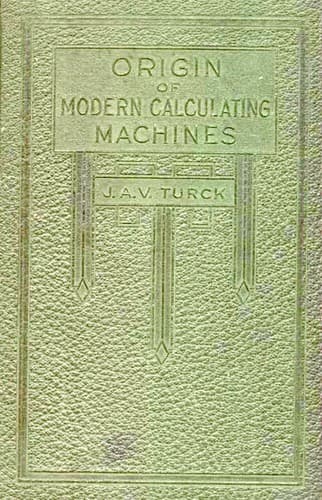
Origin of modern calculating machinesTurck, J. A. V.
History
Origin of modern calculating machines
Turck, J. A. V.
Calculators
[Sidenote: _Control of the carry by the next higher actuator_]
While the genus of this elastic keyboard invention consisted of control
of the carry by the next higher actuator, the specie of the generic
feature shown was the delayed control. The first production of this
generic feature of control of the carry by the next higher actuator
that gave the elastic keyboard-action is shown in the two Felt patents.
It may be argued that this new keyboard feature was simultaneity of
key-action and that simultaneity of keyboard-action was old. True
it was old, but the flexible simultaneity was new and depended upon
individuality of ordinal control for its creation, and Felt created the
ordinal control that gave the flexible keyboard.
Simultaneity of key-action was old in key-driven cash registers; such
invention as had been disclosed in this line, however, would defeat
the usefulness of simultaneity in a key-driven calculator. The useful
feature of depressing keys in several orders at once in a key-driven
calculating machine lay only in the increased speed of manipulation
that it could offer.
[Sidenote: _Forced simultaneous key-action old_]
Now such simultaneous key-action as had been invented and used on
cash registers was not designed with the thought of increasing the
speed of manipulation in such machines. The simultaneity of the cash
register was designed to compel the operator to depress the keys,
which represented the amount of the purchase, exactly simultaneous;
otherwise, by manipulation the proper registration could be made to
show on the sight-register and a short amount on the total-register.
It was a device to keep the clerk or salesman straight and prevent
dishonesty.
[Sidenote: _Forced simultaneity applied to a calculator impossible_]
If you have ever watched an expert operator using a “Comptometer,”
try to imagine that operator hesitating to select a group of keys and
depressing them exactly simultaneously as one is compelled to do on one
of the key-driven cash registers. And then, on the other hand, if you
have ever seen a key-driven cash register operated, try to imagine its
being operated at the lightning speed at which the “Comptometer” is
operated.[4]
[4] In making this comparison, the reader should be careful not to
confuse the later key-set crank-driven type like that of Pottin
described in the preceding chapter. It was the old key-driven type of
cash register which contained the forced simultaneity of key-action.
It must be understood that the exact or forced simultaneity of the cash
register scheme, if applied to a calculating machine, would lock the
whole keyboard if one of any of a group of keys the operator wished to
strike was depressed ahead of the others, and would thus prevent the
rest of the group from being depressed until the return of the first
key.
[Sidenote: _Flexible simultaneity of key-action a Felt invention_]
Public-domain text, read in full here on John Shaqi.
Reviews
Reviews
No reviews yet
Be the first to share your thoughts on this work.
Join the Discussion
Join the discussion
Sign in to leave a comment or review.
Sign InorCreate an account