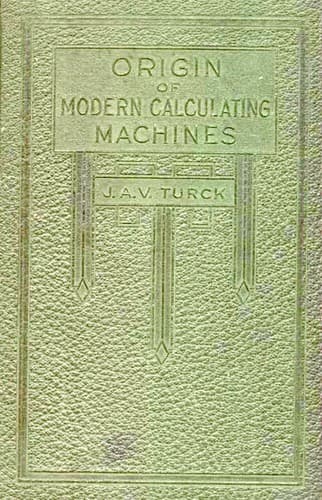
Origin of modern calculating machinesTurck, J. A. V.
History
Origin of modern calculating machines
Turck, J. A. V.
Calculators
The statement seems extremely peculiar after paying tribute to Felt
as the pioneer in the Art of adding machines. One would suppose that
having knowledge enough of the Art to offer such tribute would have
left them better advised on the subject of visible recording.
[Illustration: Two Pages from Booklet Issued by Wales Adding Machine
Co.]
[Sidenote: _Error key_]
The first of the later improvements in the key-set crank-operated
recorder were made by Burroughs and consisted of the features which
formed a part of Burroughs patent No. 504,963 of 1893. One of these
features consisted of means provided in the shape of a special key
that when depressed would clear the key-setting, thus allowing of an
erroneous key-setting to be corrected by clearing and resetting the
correct item.
[Sidenote: _Sub-total_]
Another feature was provision for printing a total at any time without
clearing the machine, thus allowing printing of what may be called a
sub-total, while the grand total is carried on to be printed later.
[Sidenote: _Repeat key_]
The third feature consisted of means for repeated addition and
recording of the same item. The means provided consisted of a key,
which, if depressed after setting an item on the keys, would prevent
the keys from being cleared; thus by repeated operation of the
hand-crank the item set up would be printed and added repeatedly.
[Sidenote: _Locked keyboard_]
The next feature was one of construction, as it was designed to
overcome the possibility of the setting of two keys in the same order,
by locking all the other keys in that order. The invention was shown
applied to the Burroughs machine, but was applied for by Wm. H. Pike
Jr., and was issued January 13, 1898.
[Sidenote: _Quick paper return_]
In 1900 Felt perfected a quick paper return for his wide paper-carriage
and applied for a patent, which was issued March 11, 1902, the number
of which is 694,955. The feature was, that by operating a lever, it
served to return the paper after recording a column of items and
automatically shifted the carriage ready for the recording of another
column of items, thus facilitating speedy operation.
[Sidenote: _Paper stop_]
In March, 1902, a patent was allowed Felt on means to lock the
mechanism in a recorder when the paper was about to run out of the
rolls; a feature which, in tabulating, served as a check against the
paper running out of the rolls and prevented further operation until
the paper was shifted to commence a new column of items, thus insuring
the printing of each record on the paper which formerly depended upon
the vigilance of the operator.
[Sidenote: _Cross tabulating_]
Public-domain text, read in full here on John Shaqi.
Reviews
Reviews
No reviews yet
Be the first to share your thoughts on this work.
Elsewhere in the archive
Join the Discussion
Join the discussion
Sign in to leave a comment or review.
Sign InorCreate an account