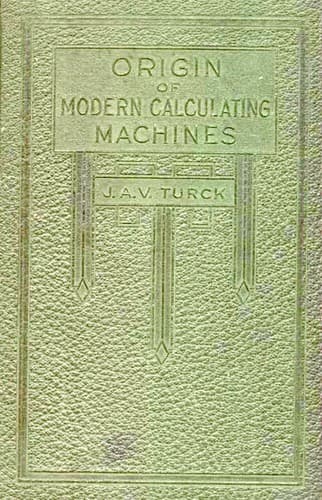
Origin of modern calculating machinesTurck, J. A. V.
History
Origin of modern calculating machines
Turck, J. A. V.
Calculators
It is unnecessary to go into the history of the Hopkins Bookkeeping
Machine to show the evolution of the Art relative to this class of
machines, as the features that have made such a machine practical were
developed by Hopkins himself, and at the present date there is none to
dispute the title since his is the only machine having the required
combination referred to. The scheme used by Hopkins for multiplication
in his billing machine is, as stated, direct multiplication or that
of adding the multiples of digits directly to the accumulator numeral
wheels instead of pumping it into the accumulator wheels by repeated
addition of the digits as is more commonly used.
[Illustration: John Napier]
The direct method of multiplying is old, as a matter of fact, the first
mechanical means employed for multiplying worked by the direct method.
But its combination with recording and typewriter mechanism invented by
Hopkins was new.
[Sidenote: _Napier’s bones first direct multiplier_]
Napier, in 1620, laid the foundation of the mechanical method of direct
multiplication when he invented his multiplying bones. The scheme of
overlapping the ordinal places is shown in the diagonal lines used to
separate units from the tens in each multiple of the nine digits (see
illustration, page 179), thus providing a convenient means by which the
ordinal values may be added together.
[Sidenote: _First direct multiplying machine_]
The first attempt to set Napier’s scheme to mechanism that would add
and register the overlapping ordinal values was patented by E. D.
Barbour in 1872. See reproduction of patent drawings on opposite page.
THE BARBOUR MULTIPLIER
The accumulator mechanism of the Barbour machine, including the numeral
wheels and their devices for transferring the tens, is mounted in a
sliding carriage at the top of the machine (see Fig. 1), which may be
operated by the hand-knob.
[Sidenote: Description of Barbour Multiplier]
Extending through the bottom of the carriage are a series of pinions,
one for each ordinal numeral wheel, and connected thereto by a ratchet
and pawl action. The pinions are each so arranged as to be operative
with a gear rack beneath the carriage when the carriage is slid back
and forth.
Thus the wheels received action from one direction of the motion of the
carriage and remain idle during the movement in the other direction.
The degree of motion so received would, of course, depend upon the
number of teeth in the racks below encountered by the pinions.
The gear racks employed by Barbour were numerous, one being provided
for each multiple of the nine digits, arranged in groups constituting
nine sets mounted on the drums marked B (see Fig. 4). Each of these
sets contain nine mutilated gear racks, the arrangement of the teeth of
which serve as the multiples of the digit they represent.
Public-domain text, read in full here on John Shaqi.
Reviews
Reviews
No reviews yet
Be the first to share your thoughts on this work.
Elsewhere in the archive
Join the Discussion
Join the discussion
Sign in to leave a comment or review.
Sign InorCreate an account