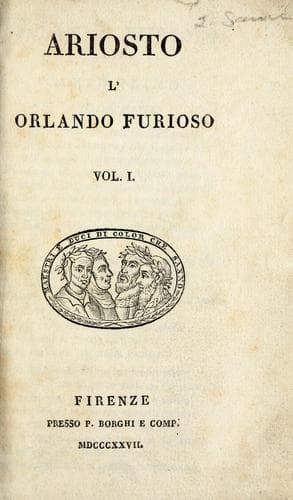
Epic poetry, Italian -- Translations into English; Knights and knighthood -- Poetry; Roland (Legendary character) -- Romances
XXXI
" `How well thou mightst have given, and without stain
Of thine own honour, what I sought of thee!
Now of so rigorous mood the worthy gain
Have and enjoy. In close captivity
Thou art; nor ever hope to break thy chain,
Unless thou soften thy obduracy.
But, if compliant, I a mean can frame
To render thee thy liberty and fame.'
XXXII
" `No, no; have thou no hope,' (replied the knight,)
`That my true faith shall ever change, although
It thus should happen that, against all right,
I should so hard a sentence undergo.
Let the world blame. Enough that in HIS sight
-- Who sees and judges every thing below,
And in HIS grace divine my fame can clear --
My innocence unsullied shall appear.
XXXIII
" `Does not Argaeus deem enough to sty
Me in his prison, let him take away
This noisome life. Nor yet may Heaven deny
Its meed, though ill the world my work appay.
And yet he who condemns me may, when I
Am parted from this tenement of clay,
Perceive that he has wronged me in the end,
And shall bewail when dead his faithful friend.'
XXXIV
"Thus oftentimes that shameless woman prest
The good Philander, but obtained no fruit.
Nursing her blind desires, which knew not rest
In seeking what her wicked love may boot,
She her old vices, in her inmost breast,
Ransacks for what may best the occasion suit,
And sifts them all: then, having overrun
A thousand evil thoughts, resolved on one.
XXXV
"Six months she waited ere again she sought
The prisoner's tower, as she was wont before:
From which the sad Philander hoped and thought
That love to him the dame no longer bore.
Lo! Fortune for her an occasion wrought,
(To evil deed propitious evermore)
To give effect, with memorable ill,
To her irrational and evil will.
XXXVI
"The husband had an ancient feud with one
Who was by name Morando hight the fair;
Who even within the fort would often run
In its lord's absence; but the knight's repair
At the wide distance of ten miles would shun,
Was he assured the castellain was there:
Who now, to lure him thither, bruited how
He for Jerusalem was bound by vow.
XXXVII
"Said he would go; and went. Thus each who spies
His outset, of his journey spreads the fame:
Nor he, who only on his wife relies,
Trusts any with his purpose but the dame,
And home returned when dusky waxed the skies;
Nor ever, save at evening, thither came;
And with changed ensigns, at the dawn of day,
Unseen of any, always went his way.
XXXVIII
"He now on this side, now on the other side,
Roved round his castle but to ascertain
If credulous Morando, who to ride
Thither was wonted, would return again.
All day he in the forest used to hide,
And, when he saw the sun beneath the main,
Came to the tower, and, through a secret gate,
Was there admitted by his faithless mate.
Public-domain text, read in full here on John Shaqi.
Reviews
Reviews
No reviews yet
Be the first to share your thoughts on this work.
Elsewhere in the archive
Join the Discussion
Join the discussion
Sign in to leave a comment or review.
Sign InorCreate an account