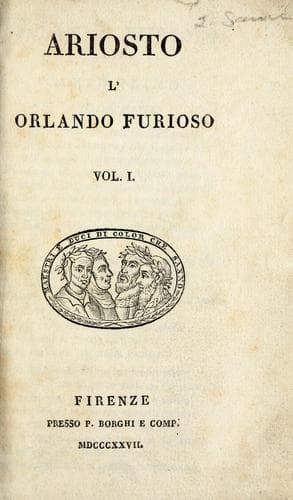
Epic poetry, Italian -- Translations into English; Knights and knighthood -- Poetry; Roland (Legendary character) -- Romances
XXXVI
She cannot, will not, think that he is dead;
Because the wreck of such a noble knight
Would, from Hydaspes' distant waves have spread,
To where the sun descends with westering light.
She knows not what to think, nor whither sped,
He roams in earth or air; yet, hapless wight,
Him ever seeks, and for attendant train
Has sobs and sighs, and every bitter pain.
XXXVII
At length to find the wondrous cave she thought,
Where the prophetic homes of Merlin lie,
And there lament herself until she wrought
Upon the pitying marble to reply;
For thence, if yet he lived would she be taught,
Of this glad life to hard necessity
Had yielded up; and, when she was possessed
Of the seer's councils, would pursue the best.
XXXVIII
With this intention, Bradamant her way
Directed thither, where in Poictier's wood
The vocal tomb, containing Merlin's clay,
Concealed in Alpine place and savage, stood.
But that enchantress sage, who night and day
Thought of the damsel, watchful for her good,
She, I repeat, who taught her what should be
In that fair grotto her posterity;
XXXIX
She who preserved her with protecting care,
That same enchantress, still benign and wise,
Who, knowing she a matchless race should bear
Of men, or rather semi-deities,
Spies daily what her thoughts and actions are,
And lots for her each day, divining, tries; --
She all Rogero's fortune knew, how freed;
Then borne to India by the griffin steed:
XL
Him on that courser plainly she had eyed,
Who would not the controlling rein obey;
When, severed by such interval, he hied,
Borne through the perilous, unwonted way:
And knew that he sport, dance, and banquet plied,
And lapt in idleness and pleasure lay;
Nor memory of his lord nor of the dame,
Once loved so well, preserved, not of his fame.
XLI
And thus such gentle knight ingloriously
Would have consumed his fairest years and best,
In long inaction, afterwards to be,
Body and soul, destroyed; and that, possessed
Alone by us in perpetuity.
That flower, whose sweets outlive the fragile rest
Which quickens man when he in earth is laid,
Would have been plucked or severed in the blade.
XLII
But that enchantress kind, who with more care
Than for himself he watched, still kept the knight,
Designed to drag him, by rough road and bare,
Towards true virtue, in his own despite;
As often cunning leech will burn and pare
The flesh, and poisonous drug employ aright:
Who, though at first his cruel art offend,
Is thanked, since he preserves us in the end.
XLIII
She, not like old Atlantes, rendered blind
By the great love she to the stripling bore,
Set not on gifting him with life her mind,
As was the scope of that enchanter hoar;
Who, reckless all of fame and praise declined,
Wished length of days to his Rogero more
Than that, to win a world's applause, the peer
Should of his joyous life forego one year.
Public-domain text, read in full here on John Shaqi.
Reviews
Reviews
No reviews yet
Be the first to share your thoughts on this work.
Elsewhere in the archive
Join the Discussion
Join the discussion
Sign in to leave a comment or review.
Sign InorCreate an account