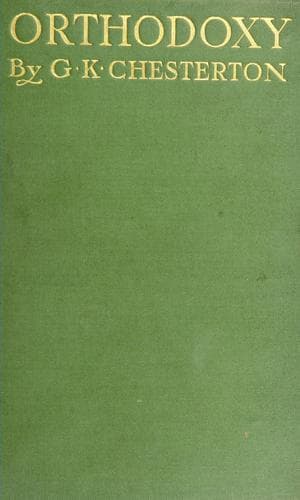
Apologetics; Chesterton, G. K. (Gilbert Keith), 1874-1936; Christianity -- Essence, genius, nature
It is customary to complain of the bustle and strenuousness of our
epoch. But in truth the chief mark of our epoch is a profound laziness
and fatigue; and the fact is that the real laziness is the cause of the
apparent bustle. Take one quite external case; the streets are noisy
with taxicabs and motor-cars; but this is not due to human activity but
to human repose. There would be less bustle if there were more activity,
if people were simply walking about. Our world would be more silent if
it were more strenuous. And this which is true of the apparent physical
bustle is true also of the apparent bustle of the intellect. Most of the
machinery of modern language is labour-saving machinery; and it saves
mental labour very much more than it ought. Scientific phrases are used
like scientific wheels and piston-rods to make swifter and smoother yet
the path of the comfortable. Long words go rattling by us like long
railway trains. We know they are carrying thousands who are too tired or
too indolent to walk and think for themselves. It is a good exercise to
try for once in a way to express any opinion one holds in words of one
syllable. If you say "The social utility of the indeterminate sentence
is recognised by all criminologists as a part of our sociological
evolution towards a more humane and scientific view of punishment," you
can go on talking like that for hours with hardly a movement of the grey
matter inside your skull. But if you begin "I wish Jones to go to gaol
and Brown to say when Jones shall come out," you will discover, with a
thrill of horror, that you are obliged to think. The long words are not
the hard words, it is the short words that are hard. There is much more
metaphysical subtlety in the word "damn" than in the word
"degeneration."
But these long comfortable words that save modern people the toil of
reasoning have one particular aspect in which they are especially
ruinous and confusing. This difficulty occurs when the same long word is
used in different connections to mean quite different things. Thus, to
take a well-known instance, the word "idealist" has one meaning as a
piece of philosophy and quite another as a piece of moral rhetoric. In
the same way the scientific materialists have had just reason to
complain of people mixing up "materialist" as a term of cosmology with
"materialist" as a moral taunt. So, to take a cheaper instance, the man
who hates "progressives" in London always calls himself a "progressive"
in South Africa.
Public-domain text, read in full here on John Shaqi.
Reviews
Reviews
No reviews yet
Be the first to share your thoughts on this work.
Elsewhere in the archive
Join the Discussion
Join the discussion
Sign in to leave a comment or review.
Sign InorCreate an account