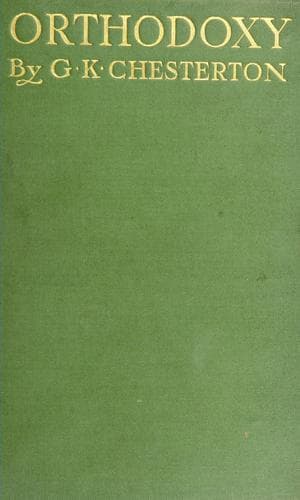
Apologetics; Chesterton, G. K. (Gilbert Keith), 1874-1936; Christianity -- Essence, genius, nature
A short time ago Mrs. Besant, in an interesting essay, announced that
there was only one religion in the world, that all faiths were only
versions or perversions of it, and that she was quite prepared to say
what it was. According to Mrs. Besant this universal Church is simply
the universal self. It is the doctrine that we are really all one
person; that there are no real walls of individuality between man and
man. If I may put it so, she does not tell us to love our neighbours;
she tells us to be our neighbours. That is Mrs. Besant's thoughtful and
suggestive description of the religion in which all men must find
themselves in agreement. And I never heard of any suggestion in my life
with which I more violently disagree. I want to love my neighbour not
because he is I, but precisely because he is not I. I want to adore the
world, not as one likes a looking-glass, because it is one's self, but
as one loves a woman, because she is entirely different. If souls are
separate love is possible. If souls are united love is obviously
impossible. A man may be said loosely to love himself, but he can hardly
fall in love with himself, or, if he does, it must be a monotonous
courtship. If the world is full of real selves, they can be really
unselfish selves. But upon Mrs. Besant's principle the whole cosmos is
only one enormously selfish person.
It is just here that Buddhism is on the side of modern pantheism and
immanence. And it is just here that Christianity is on the side of
humanity and liberty and love. Love desires personality; therefore love
desires division. It is the instinct of Christianity to be glad that God
has broken the universe into little pieces, because they are living
pieces. It is her instinct to say "little children love one another"
rather than to tell one large person to love himself. This is the
intellectual abyss between Buddhism and Christianity; that for the
Buddhist or Theosophist personality is the fall of man, for the
Christian it is the purpose of God, the whole point of his cosmic idea.
The world-soul of the Theosophists asks man to love it only in order
that man may throw himself into it. But the divine centre of
Christianity actually threw man out of it in order that he might love
it. The oriental deity is like a giant who should have lost his leg or
hand and be always seeking to find it; but the Christian power is like
some giant who in a strange generosity should cut off his right hand, so
that it might of its own accord shake hands with him. We come back to
the same tireless note touching the nature of Christianity; all modern
philosophies are chains which connect and fetter; Christianity is a
sword which separates and sets free. No other philosophy makes God
actually rejoice in the separation of the universe into living souls.
But according to orthodox Christianity this separation between God and
man is sacred, because this is eternal. That a man may love God it is
Public-domain text, read in full here on John Shaqi.
Reviews
Reviews
No reviews yet
Be the first to share your thoughts on this work.
Elsewhere in the archive
Join the Discussion
Join the discussion
Sign in to leave a comment or review.
Sign InorCreate an account