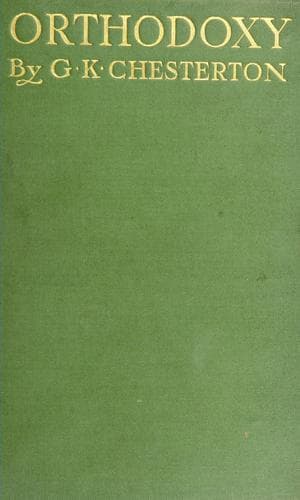
Apologetics; Chesterton, G. K. (Gilbert Keith), 1874-1936; Christianity -- Essence, genius, nature
If I am asked, as a purely intellectual question, why I believe in
Christianity, I can only answer, "For the same reason that an
intelligent agnostic disbelieves in Christianity." I believe in it
quite rationally upon the evidence. But the evidence in my case, as in
that of the intelligent agnostic, is not really in this or that alleged
demonstration; it is in an enormous accumulation of small but unanimous
facts. The secularist is not to be blamed because his objections to
Christianity are miscellaneous and even scrappy; it is precisely such
scrappy evidence that does convince the mind. I mean that a man may well
be less convinced of a philosophy from four books, than from one book,
one battle, one landscape, and one old friend. The very fact that the
things are of different kinds increases the importance of the fact that
they all point to one conclusion. Now, the non-Christianity of the
average educated man to-day is almost always, to do him justice, made up
of these loose but living experiences. I can only say that my evidences
for Christianity are of the same vivid but varied kind as his evidences
against it. For when I look at these various anti-Christian truths, I
simply discover that none of them are true. I discover that the true
tide and force of all the facts flows the other way. Let us take cases.
Many a sensible modern man must have abandoned Christianity under the
pressure of three such converging convictions as these: first, that
men, with their shape, structure, and sexuality, are, after all, very
much like beasts, a mere variety of the animal kingdom; second, that
primeval religion arose in ignorance and fear; third, that priests have
blighted societies with bitterness and gloom. Those three anti-Christian
arguments are very different; but they are all quite logical and
legitimate; and they all converge. The only objection to them (I
discover) is that they are all untrue. If you leave off looking at books
about beasts and men, if you begin to look at beasts and men then (if
you have any humour or imagination, any sense of the frantic or the
farcical) you will observe that the startling thing is not how like man
is to the brutes, but how unlike he is. It is the monstrous scale of his
divergence that requires an explanation. That man and brute are like is,
in a sense, a truism; but that being so like they should then be so
insanely unlike, that is the shock and the enigma. That an ape has hands
is far less interesting to the philosopher than the fact that having
hands he does next to nothing with them; does not play knuckle-bones or
the violin; does not carve marble or carve mutton. People talk of
barbaric architecture and debased art. But elephants do not build
colossal temples of ivory even in a roccoco style; camels do not paint
even bad pictures, though equipped with the material of many
camel's-hair brushes. Certain modern dreamers say that ants and bees
have a society superior to ours. They have, indeed, a civilisation; but
Public-domain text, read in full here on John Shaqi.
Reviews
Reviews
No reviews yet
Be the first to share your thoughts on this work.
Elsewhere in the archive
Join the Discussion
Join the discussion
Sign in to leave a comment or review.
Sign InorCreate an account