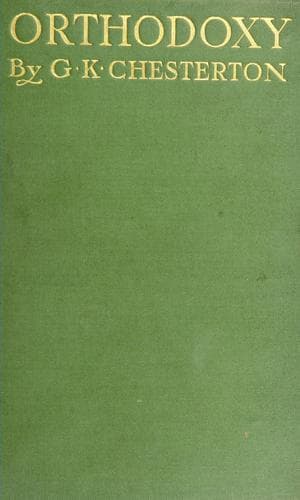
Apologetics; Chesterton, G. K. (Gilbert Keith), 1874-1936; Christianity -- Essence, genius, nature
I have given an imaginary triad of such ordinary anti-Christian
arguments; if that be too narrow a basis I will give on the spur of the
moment another. These are the kind of thoughts which in combination
create the impression that Christianity is something weak and diseased.
First, for instance, that Jesus was a gentle creature, sheepish and
unworldly, a mere ineffectual appeal to the world; second, that
Christianity arose and flourished in the dark ages of ignorance, and
that to these the Church would drag us back; third, that the people
still strongly religious or (if you will) superstitious--such people as
the Irish--are weak, unpractical, and behind the times. I only mention
these ideas to affirm the same thing: that when I looked into them
independently I found, not that the conclusions were unphilosophical,
but simply that the facts were not facts. Instead of looking at books
and pictures about the New Testament I looked at the New Testament.
There I found an account, not in the least of a person with his hair
parted in the middle or his hands clasped in appeal, but of an
extraordinary being with lips of thunder and acts of lurid decision,
flinging down tables, casting out devils, passing with the wild secrecy
of the wind from mountain isolation to a sort of dreadful demagogy; a
being who often acted like an angry god--and always like a god. Christ
had even a literary style of his own, not to be found, I think,
elsewhere; it consists of an almost furious use of the _a fortiori_.
His "how much more" is piled one upon another like castle upon castle in
the clouds. The diction used _about_ Christ has been, and perhaps
wisely, sweet and submissive. But the diction used by Christ is quite
curiously gigantesque; it is full of camels leaping through needles and
mountains hurled into the sea. Morally it is equally terrific; he called
himself a sword of slaughter, and told men to buy swords if they sold
their coats for them. That he used other even wilder words on the side
of non-resistance greatly increases the mystery; but it also, if
anything, rather increases the violence. We cannot even explain it by
calling such a being insane; for insanity is usually along one
consistent channel. The maniac is generally a monomaniac. Here we must
remember the difficult definition of Christianity already given;
Christianity is a superhuman paradox whereby two opposite passions may
blaze beside each other. The one explanation of the Gospel language that
does explain it, is that it is the survey of one who from some
supernatural height beholds some more startling synthesis.
Public-domain text, read in full here on John Shaqi.
Reviews
Reviews
No reviews yet
Be the first to share your thoughts on this work.
Elsewhere in the archive
Join the Discussion
Join the discussion
Sign in to leave a comment or review.
Sign InorCreate an account