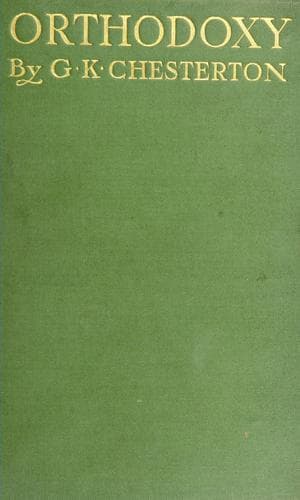
Apologetics; Chesterton, G. K. (Gilbert Keith), 1874-1936; Christianity -- Essence, genius, nature
In the last chapter it has been said that the primary feeling that this
world is strange and yet attractive is best expressed in fairy tales.
The reader may, if he likes, put down the next stage to that bellicose
and even jingo literature which commonly comes next in the history of a
boy. We all owe much sound morality to the penny dreadfuls. Whatever the
reason, it seemed and still seems to me that our attitude towards life
can be better expressed in terms of a kind of military loyalty than in
terms of criticism and approval. My acceptance of the universe is not
optimism, it is more like patriotism. It is a matter of primary loyalty.
The world is not a lodging-house at Brighton, which we are to leave
because it is miserable. It is the fortress of our family, with the flag
flying on the turret, and the more miserable it is the less we should
leave it. The point is not that this world is too sad to love or too
glad not to love; the point is that when you do love a thing, its
gladness is a reason for loving it, and its sadness a reason for loving
it more. All optimistic thoughts about England and all pessimistic
thoughts about her are alike reasons for the English patriot. Similarly,
optimism and pessimism are alike arguments for the cosmic patriot.
Let us suppose we are confronted with a desperate thing--say Pimlico.
If we think what is really best for Pimlico we shall find the thread of
thought leads to the throne of the mystic and the arbitary. It is not
enough for a man to disapprove of Pimlico: in that case he will merely
cut his throat or move to Chelsea. Nor, certainly, is it enough for a
man to approve of Pimlico: for then it will remain Pimlico, which would
be awful. The only way out of it seems to be for somebody to love
Pimlico: to love it with a transcendental tie and without any earthly
reason. If there arose a man who loved Pimlico, then Pimlico would rise
into ivory towers and golden pinnacles; Pimlico would attire herself as
a woman does when she is loved. For decoration is not given to hide
horrible things; but to decorate things already adorable. A mother does
not give her child a blue bow because he is so ugly without it. A lover
does not give a girl a necklace to hide her neck. If men loved Pimlico
as mothers love children, arbitarily, because it is _theirs_ Pimlico in
a year or two might be fairer than Florence. Some readers will say that
this is a mere fantasy. I answer that this is the actual history of
mankind. This, as a fact, is how cities did grow great. Go back to the
darkest roots of civilisation and you will find them knotted round some
sacred stone or encircling some sacred well. People first paid honour to
a spot and afterwards gained glory for it. Men did not love Rome because
she was great. She was great because they had loved her.
Public-domain text, read in full here on John Shaqi.
Reviews
Reviews
No reviews yet
Be the first to share your thoughts on this work.
Elsewhere in the archive
Join the Discussion
Join the discussion
Sign in to leave a comment or review.
Sign InorCreate an account