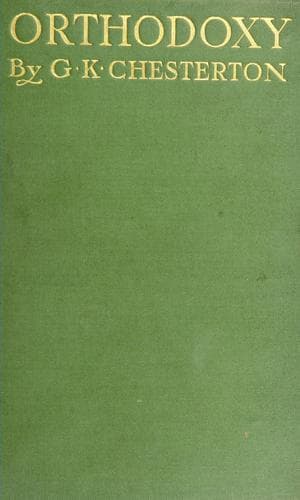
Apologetics; Chesterton, G. K. (Gilbert Keith), 1874-1936; Christianity -- Essence, genius, nature
Here it was that I first found that my wandering feet were in some
beaten track. Christianity had also felt this opposition of the martyr
to the suicide: had it perhaps felt it for the same reason? Had
Christianity felt what I felt, but could not (and cannot) express--this
need for a first loyalty to things, and then for a ruinous reform of
things? Then I remembered that it was actually the charge against
Christianity that it combined these two things which I was wildly trying
to combine. Christianity was accused, at one and the same time, of being
too optimistic about the universe and of being too pessimistic about the
world. The coincidence made me suddenly stand still.
An imbecile habit has arisen in modern controversy of saying that such
and such a creed can be held in one age but cannot be held in another.
Some dogma, we are told, was credible in the twelfth century, but is not
credible in the twentieth. You might as well say that a certain
philosophy can be believed on Mondays, but cannot be believed on
Tuesdays. You might as well say of a view of the cosmos that it was
suitable to half-past three, but not suitable to half-past four. What a
man can believe depends upon his philosophy, not upon the clock or the
century. If a man believes in unalterable natural law, he cannot believe
in any miracle in any age. If a man believes in a will behind law, he
can believe in any miracle in any age. Suppose, for the sake of
argument, we are concerned with a case of thaumaturgic healing. A
materialist of the twelfth century could not believe it any more than a
materialist of the twentieth century. But a Christian Scientist of the
twentieth century can believe it as much as a Christian of the twelfth
century. It is simply a matter of a man's theory of things. Therefore in
dealing with any historical answer, the point is not whether it was
given in our time, but whether it was given in answer to our question.
And the more I thought about when and how Christianity had come into the
world, the more I felt that it had actually come to answer this
question.
Public-domain text, read in full here on John Shaqi.
Reviews
Reviews
No reviews yet
Be the first to share your thoughts on this work.
Elsewhere in the archive
Join the Discussion
Join the discussion
Sign in to leave a comment or review.
Sign InorCreate an account