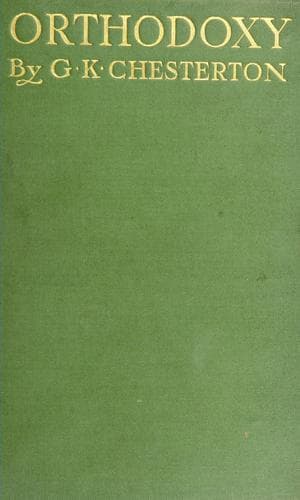
Apologetics; Chesterton, G. K. (Gilbert Keith), 1874-1936; Christianity -- Essence, genius, nature
It was the prime philosophic principle of Christianity that this divorce
in the divine act of making (such as severs the poet from the poem or
the mother from the new-born child) was the true description of the act
whereby the absolute energy made the world. According to most
philosophers, God in making the world enslaved it. According to
Christianity, in making it, He set it free. God had written, not so much
a poem, but rather a play; a play he had planned as perfect, but which
had necessarily been left to human actors and stage-managers, who had
since made a great mess of it. I will discuss the truth of this theorem
later. Here I have only to point out with what a startling smoothness it
passed the dilemma we have discussed in this chapter. In this way at
least one could be both happy and indignant without degrading one's self
to be either a pessimist or an optimist. On this system one could fight
all the forces of existence without deserting the flag of existence. One
could be at peace with the universe and yet be at war with the world.
St. George could still fight the dragon, however big the monster bulked
in the cosmos, though he were bigger than the mighty cities or bigger
than the everlasting hills. If he were as big as the world he could yet
be killed in the name of the world. St. George had not to consider any
obvious odds or proportions in the scale of things, but only the
original secret of their design. He can shake his sword at the dragon,
even if it is everything; even if the empty heavens over his head are
only the huge arch of its open jaws.
Public-domain text, read in full here on John Shaqi.
Reviews
Reviews
No reviews yet
Be the first to share your thoughts on this work.
Elsewhere in the archive
Join the Discussion
Join the discussion
Sign in to leave a comment or review.
Sign InorCreate an account